CHRO or CAT? is the ‘chief architect of transformation’ the new CHRO?
reimagine. reshape. redesign.
There’s a theme in Randstad’s new research on the role of the CHRO (Well, there are a few themes, but we’ll get to that later). The main one is “Re-.” Boards, businesses and bosses are calling for change. Driven by competitive pressure, shareholders and FOMO, the opportunity to shift the cost to income ratio is just too good to ignore.
But to realize those gains, CEOs depend on getting the tech right, managing AI costs and re-pointing a workforce at large. The larger the workforce, the harder it is to turn the ship. With AI-first rubber duckies launching by the minute, no wonder the captain’s outlook from the wheelhouse, incites fear and FOMO. This is a people problem. And a tech problem. One cannot succeed without the other.
And so, if CHROs can answer this question, they have an opportunity to help take the wheel and turn the ship, to chart the course.
The problem is, this is no small feat of engineering.
“CHROs are poised to act as transformation architects, redesigning work and supporting structures to unlock growth. But much like creating buildings that stand the test of time, this requires vision, collaboration and critical thinking — supported by technology.”
Randstad, “Architects of work: the evolving role of the CHRO” report
what are CEOs looking for in a CHRO today?
How is the role evolving? What experience will equip a CHRO to steer through this uncharted territory?
We’re hearing:
- Workforce transformation (e.g., HRIS implementation) or major operating model transformations
- Change management at scale
- AI-transformation: but this experience is hard to find because few have done it yet!
Randstad’s data bears this out. Across 26 global companies in five sectors, job postings for Directors of Transformation grew 262% in the first seven months of 2026, with Transformation Consultants (+234%) and Change Management Consultants (+221%) close behind. Demand is surging for exactly the experience that’s in shortest supply.
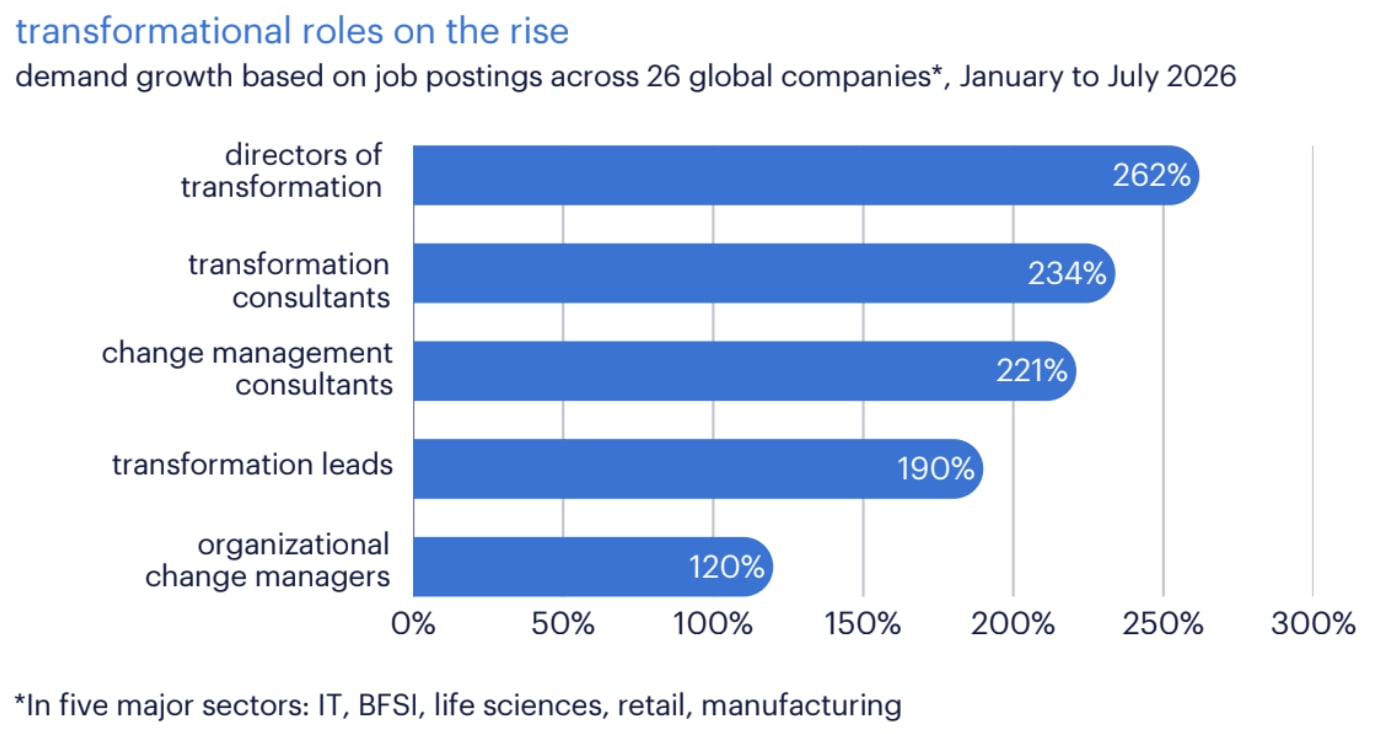
Source: Randstad, “Architects of work: the evolving role of CHROs,” (2026), job-posting analysis January–July 2026
6 core capabilities in the future for CHROs
I asked Sam Schlimpler, managing director of Randstad Advisory for her perspective, based on the work her team does across the globe. She sees six core capabilities in the future for CHROs:
- CEO expectations and the role of the CHRO as an architect of work: CEOs are seeking CHROs who act primarily as business leaders and architects of work. This role requires evaluating whether organizations possess the necessary human and synthetic capabilities to handle current, upcoming and future work requirements.
- Operational governance and strategic leadership: In addition to serving as architects of work, CHROs are expected to ensure that operational transactions run smoothly, governance is maintained, risk and reputation are managed, and people data is handled effectively, all while strategically driving the organizational agenda.
- Evolution of function experiences and operating model shift: The experiences required for the CHRO function have shifted over time, moving from business partnership to self-service models. Although organizational design and effectiveness skills are valuable, the function has historically focused heavily on cost efficiency, indicating a need to revive these past skills and establish a new operating model focused on value rather than past structures.
- Outcome-focused systems and unique organizational positioning: Operating models should be designed around required outcomes and initiated in key critical areas rather than relying on traditional structures. The CHRO holds a unique position capable of seeing across people elements while serving as a moral compass, social engineer and architect of work.
- Technological agility and adaptive systems of work: Current hiring priorities focus on agility and the ability to understand and apply technology through both technological and human lenses. Systems of work should be built with internal agility to proactively respond to future waves, avoiding static structures that require complete replacement.
- Hiring priorities in data analytics and transformation: Data analytics is an essential skill for making insights-led decisions. Additionally, current hiring focuses on systems engineering, design skills and transformation expertise geared toward working transformation, rather than mere project transformation.
What capabilities can CHROs draw from their toolkit? What are the critical skills being hired for now? Randstad reports: “Leaders must pair AI fluency and organizational insight to master ‘AI wisdom.’ This means knowing when the technology should be deployed, not just when it can be, and developing skills in behavioral science, data and change management.”
what can CHROs do now?
Our view: learn and practice workforce redesign. You can learn fast from those who’ve done it, then build the playbook and capability in your team. Get the reps — practice on yourself and learn. Profile your case studies with a focus on business performance, tech and people outcomes.
what’s it going to take to get there?
1. reskilling or finding the right talent
The most valuable skills are the hardest to find, so an agile sourcing model is central to a workforce planning strategy. The role design work Beamible does is seeking to amplify the time human workers spend in work which requires:
- Human judgement in order to deliver value
- Risk management and governance over AI agents, strategy and AI-augmented human work
- Creative problem-solving for exceptions which AI cannot handle
- Innovation to build competitive differentiation
- Stakeholder management and engagement — internal and external
- Customer value moments for your most important customers
Randstad’s research shows that 35% of business leaders are finding it hard to recruit for human skills (eg. critical thinking, creative problem solving) and 61% are finding it difficult to recruit for strong communication and stakeholder management.
It is therefore a critical workforce planning priority to have diverse avenues to build, borrow, buy, bot, blend and bounce critical skills so the business doesn’t stall.
“AI is driving a rapid shift in how leaders organize work, creating a more fluid environment. As market opportunities and technology capabilities evolve, so will workflows and workforce requirements.”
Randstad report, “Architects of work: the evolving role of CHROs.”
2. design for humans, not at the expense of business performance, but to drive it
There is a risk that comes with narratives that undermine the ROI that HR is delivering on the AI strategy. So, it’s important to note that this is not a “happy clappy” exercise (as one CHRO described the risk to me recently), ignoring the realities of businesses who depend on a competitive cost-to-income ratio. Rather, and this is important:
Value from AI will only be released for the business, if it amplifies the impact, performance and effort of the people, the humans, who are the other part of the equation.
CHROs will need to define what human-AI synergy looks like for their organizations. This means understanding where uniquely human skills are best supported by technology, especially when it comes to customer- and talent-facing situations. Where this unique value is depends on your strategy: Is the customer experience going to drive income? Will R&D innovation drive income, so the employee experience is number one? Will new products drive income, requiring speed to market, an op model to unlock silos?
transform workflows: where tech and people co-deliver high impact delivery
Get clear on what organizational capability will drive revenue growth and focus on the game-changing workflows that will deliver it.
At Beamible, we are seeing leading organizations transform the critical workflows for an organization or function. For many, this type of work has been reserved for long and burdensome process mapping exercises. However Lean experts may be having a renaissance, as now technology is able to facilitate fast, accurate process maps, which also link back to the jobs people do.
One important principle in tackling workflow transformation is that a work activity belongs to a process, but also to a job; the workflow may involve many types of job profiles end-to-end. So while this type of transformation may seem overwhelming, the benefits in ROI — capacity saved and output quality — make it well worthwhile. There is a methodology to follow, and it is a capability you can build in-house.
“While different solutions will suit different organizations, a common thread is the need to link both workforce transformation and technology deployment to outcomes. This way, leaders can gain greater visibility into how work must be designed and carried out to realize their business ambitions.”
Randstad report, “Architects of work: the evolving role of CHROs.”
3 key imperatives for successful transformation
Randstad concludes through its research that these are:
-
CHROs have a vital role to play in rebuilding structures so the benefits of the technology are felt across their organizations.
Realizing this vision requires a connected data infrastructure, the technology to visualize talent intelligence across internal and external sources and, most importantly, a true people transformation” This is an opportunity for ambitious CHROs to impact profitability and long-term business performance. A once-in-a-career opportunity to elevate HR and themselves. -
A transition of this scale requires the backing of the workforce.
Collaboration is not a nice-to-have. Redesigning workflows and job roles requires accurately understanding the work. People are the experts in the work, so their collaboration is critical to get full value from AI, but also to effective change and adoption. -
When redesigning workflows, CHROs must adopt a design-thinking approach.
The challenge lies in striking the right balance: building trust with employees while continuing to make difficult decisions rooted in sound commercial strategy.”
In our experience, this is as much about effective communication and stakeholder management as it is about the right strategy. Data helps build credibility and confidence when getting buy-in for recommendations and decisions.
"Architects of work: the evolving role of CHROs" to explore new data and hear how 13 CHROs are tackling these shifts now.
get the report.