before you automate, AI-vate or agent-icate.
reimagining work in the AI era: the questions that should come before the technology

AI implementation often fails when companies automate processes rather than rethink work. Successful digital transformation requires a disciplined sequence: define purpose, analyze tasks and force hard trade-offs before choosing tools. Find out how to avoid operational inefficiencies, human skills erosion, rubber-stamping and other pitfalls. This new white paper introduces a strategic “before you implement” framework and provides a Grid to help you assess AI suitability, identify risks of over-reliance and ensure freed capacity is reinvested in high-value, strategic work. Learn how to govern AI-driven changes as a living system to ensure transformation creates long-term value, not just a faster version of yesterday's tasks.
Many organizations are redesigning work backwards. They buy the AI, then ask what should change — this is a version of the “solution looking for a problem” approach. They often automate the work as it exists, then wonder why they don’t see any measurable ROI. They free up some of a team's time and call it a business case, without ever accounting for what the freed time becomes. The result, across industries, is the same: faster versions of yesterday's work, pilots that never scale and — quietly accumulating underneath — workforces who are losing the very capabilities that automation oversight depends on.
AI strategy doesn’t have to fail like this. But avoiding it requires something most transformation programs skip: a disciplined sequence of questions asked before any tool is chosen, with the hard trade-offs forced into the open rather than left implicit. This paper shares the framework Randstad Advisory uses with enterprise clients to do exactly that. It is a thinking rubric with nine phases, each ending with a trade-off leadership must take a position on. What follows are the ideas that do the most work.
the discipline: sequence, questions, forced trade-offs
Three design principles run through the framework.
-
- The sequence matters.
Purpose comes before analysis, analysis before deconstruction, deconstruction before automation. The most expensive failures in work redesign come from running these out of order — most commonly, thinking and acting on automation that we should actually consider eliminating. This is how organizations end up efficiently producing valueless work. - Questions beat answers.
AI capability moves quarterly; any playbook of answers is stale before it ships. The durable asset is the set of questions a leadership team asks every time — and the honesty it takes to answer them. - Trade-offs must be forced, not implied.
Every automation program embeds positions on hard questions: Should we protect entry-level work that AI could absorb? Should we keep humans in high-emotion moments at real cost? Is headcount savings or capability rebuilding is the goal?
- The sequence matters.
Most programs never state these positions; they emerge by accident and get litigated in the worst possible forum — after deployment. The framework ends every phase with a named trade-off and requires a recorded position. The accumulated log of positions becomes something valuable in its own right: the organization's automation principles and redlines, generated by decisions rather than brainstormed onto a flipchart.
start with purpose, not process
Before analyzing how work is done, recover what it exists to produce. This sounds obvious and is almost never done. Job descriptions describe activities — sources candidates, schedules interviews, processes claims — and activities are precisely the wrong unit of redesign. Automating an activity preserves the assumption that the activity should exist.
Use a simple instrument, the purpose statement: [the work] exists so that [the primary beneficiary] can [achieve an outcome], especially when [conditions], measured by [an outcome metric].
Then a simple test with disproportionate power: If we were inventing this work today, knowing what AI can now do, would we invent it in this shape at all? Any activity that cannot be traced cleanly to the purpose is a first candidate for elimination, not automation. The cheapest, fastest, safest work is the work no one has to do.
Purpose also disciplines the effort itself. Why is this redesign actually happening — productivity pressure, talent shortage, quality failure, experience improvement, strategic reinvention? Who is it primarily for — the worker, the customer, the shareholder? A redesign that will not say why it is happening usually has a reason it would rather not name, and one of the most corrosive failure modes in this space is the hidden layoff: a cost-cut wearing a redesign's clothes. If the goal is headcount reduction, name it honestly. The workforce will find out either way; only one path preserves trust.
one map before any tool: dimensionality x boundedness
The oldest sorting mechanism in automation — routine versus non-routine work — hides more than it reveals, because two tasks that look equally routine can demand opposite redesigns. Two better questions do most of the predictive work, and crossing them produces a single map we call “the Grid.”
dimensionality: how easily can the work be specified and checked?
Some work can be defined with testable acceptance criteria and verified against them. Some work resists any clean rubric because it is ambiguous, context-heavy and dependent on tacit judgment. Low-dimensional work sits below what we call the “specification ceiling” — easy to define, verify and hand to a system. High-dimensional work does not, and no amount of prompting fully closes that gap.
boundedness: is demand finite or boundless?
Some work has a natural ceiling — a bounded queue of inbound tickets. Some work is effectively unlimited: Any capacity you free simply expands the work itself.
Crossing the axes yields four quadrants, and each predicts something different:
the pressure zone (low-dimensionality, bounded)
-
- Tier-one support, data entry, routine coordination
- Easy for AI to execute, with no backlog to absorb freed capacity
- Displacement lands first and hardest here; disproportionately lower-wage, entry-level, on-ramp work
- Binding question is not whether AI can do it; it’s what happens to people and the organization, their capabilities and to the learning rungs
volume expansion (low-dimensionality, boundless)
-
- Outreach, high-volume content, first-pass screening
- Work expands to absorb freed capacity; headcount holds better than feared
- Real exposure is quality, not jobs: an ocean of cheap output nobody asked for, relationships reduced to friction with a friendly face
capped but protected (high-dimensionality, bounded)
-
- Specialist advisory, complex casework
- Hard for AI to fully do, limited in demand
- Fewer people over time, each far more leveraged
- Real risk of hollowing the role into pure oversight if redesign is careless
the frontier (high-dimensionality, boundless)
-
- Strategy, original research, complex consultative work: the genuinely hard parts of every profession
- Where freed capacity should flow; where your best people become worth more, not less
- Deciding whether transformation creates value: Is capacity actually being reallocated or banked as savings while the frontier stays understaffed?
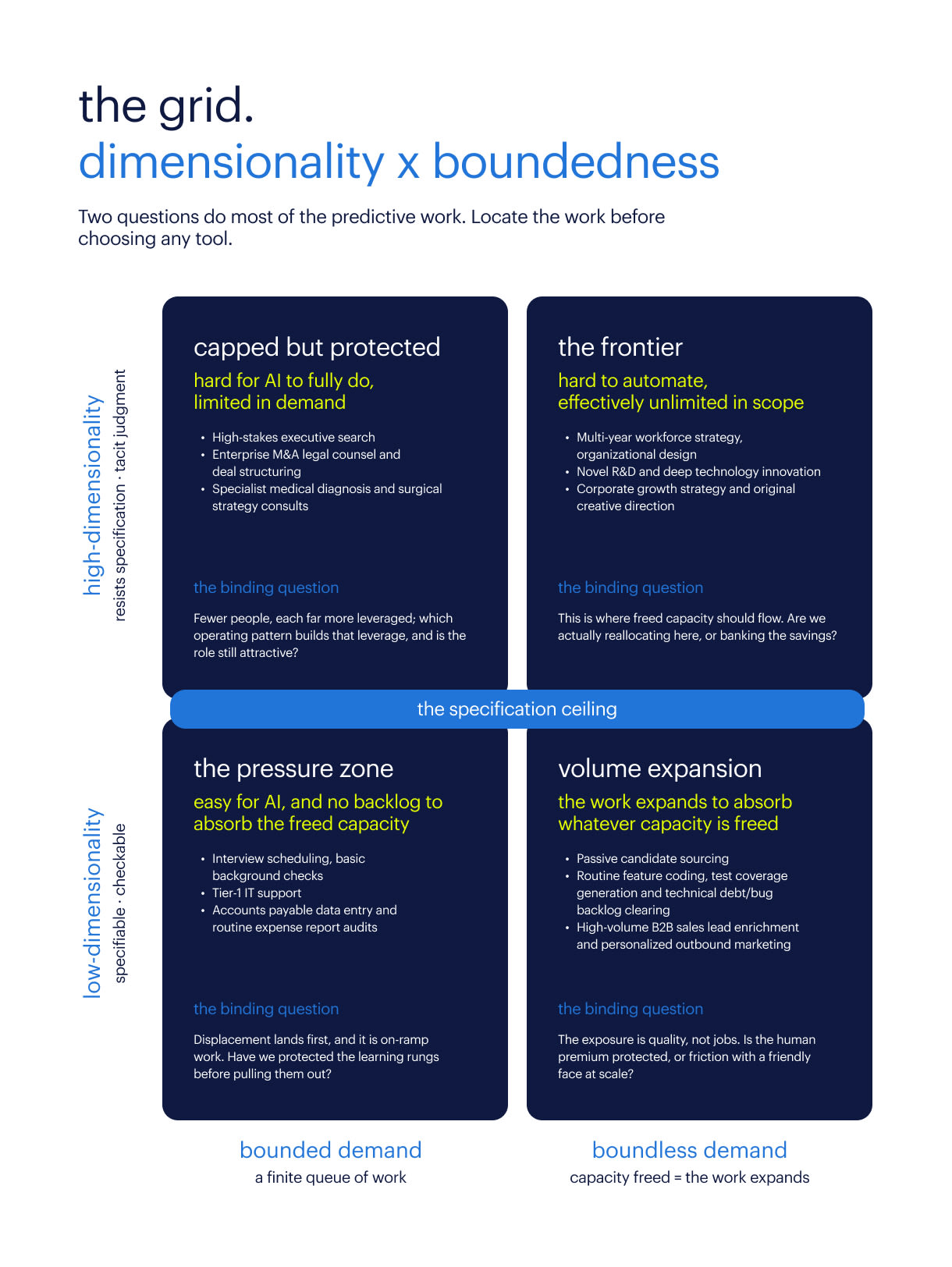
The Grid also surfaces the single most uncomfortable trade-off in work redesign. Displacement in the Pressure Zone looks efficient and obvious, but the Pressure Zone is where tomorrow's high-dimensional talent learns the craft.
Organizations that automate away the on-ramp will spend three years enjoying the savings and the next ten wondering why no one can do the Frontier work. Some low-dimensional work may be worth protecting deliberately as tuition. That is a leadership position, not an analytical output, which is exactly why the framework forces it.
where the human premium lives
“Keep humans in the loop” is a comfort, not a design principle — that is, until you can say what humans are actually for. Randstad Advisory uses one architecture with two lenses, unified by a single claim: AI has no skin in the game.
The supply side names six structurally human capacities — properties of being a person, not skills a model will eventually learn.
-
- Standing: A human can be accountable, own a decision, be questioned, bear consequences.
- Presence: Being genuinely witnessed by another person changes high-stakes moments.
- Provenance: Human involvement and judgment carries lived experience; the claim has a history a pattern-match does not.
- Perspective: Humans hold context beyond the task and notice when the right answer to the stated question is the wrong answer to the real one.
- Curiosity: Humans pursue the anomaly and ask the unprompted question.
- Taste: Humans pass judgment about quality that outruns any rubric.
The demand side names eight human premiums — the things people demonstrably pay for, in money, trust or loyalty.
-
- Relational continuity: Someone knows me.
- Embodied presence: Someone is there with me.
- Social validation: I interact with a person before I act.
- Accountability: Someone has to own this.
- Translation: I don't know how to ask for what I need.
- Behavior change: I know what to do, but I need a person to help me do it.
- Provenance, itself: “A human made it” is part of the value.
- Discretion: Someone can decide to make an exception based on circumstances.
The capacities explain why the premiums exist; the premiums tell you where to spend the capacities. Together they convert human-centeredness into an operating screen.
If a touchpoint carries no premium, and its tasks draw on no capacity — scheduling an interview draws on none of the six, for example — automate it confidently, to zero friction, without apology.
If either lens lights up — a rejection after a final round, a grievance, closing a hesitant candidate, delivering hard news, as examples — protect the human deliberately, as the last mile of the experience, and treat the cost as brand investment rather than inefficiency.
The moments are not equal, and pretending otherwise in either direction is how organizations end up automating what they should protect while hand-staffing what nobody values.
the second test: severity and reversibility
The Grid predicts where AI can act and where capacity should flow. It does not, on its own, tell you how much a human needs to be watching.
For that, a second question has to be asked of every task the Grid clears for automation: If this goes wrong, how severe will the damage be, and how easily could it be undone?
Some low-dimensionality, easily-verified work — precisely what the Grid would wave through with confidence — carries wrong-decision costs that are high and hard to reverse: a candidate wrongly rejected, a policy hallucinated and acted on, a pay decision automated at scale. The Grid alone would under-protect exactly this work, because ease of verification and cost of error measure different things.
The two tests answer two different questions:
-
- Dimensionality and boundedness tell you where automation is viable and where the freed capacity goes.
- Severity and reversibility tell you how much oversight automation needs built in from the start; the missing link between deciding a task can be automated and deciding how carefully it must be watched once it is automated.
deconstruct in the right order: eliminate, relocate, then automate
When redesign finally reaches the task level, it must run as a sequence of filters, not a single sort. First, capture the real work. Triangulate the job description (JD) against system data, observation and workers' own time diaries; the JD is a low-fidelity artifact, and the disagreement between sources is the signal worth chasing.
Next, apply the filters in order:
-
- Eliminate: Should this work exist at all? Does it trace to purpose? Does anyone consume the output? Elimination is the single highest-leverage and most under-used move in the entire discipline, and it is free.
- Relocate: Does it belong here? Could the customer self-serve it? Would an upstream change prevent it? Could a shared service do it better?
- Automate or augment only what survives.
Location decisions deserve the same reframe. When AI can be cheaper than the least expensive human worker anywhere, traditional labor arbitrage gives way to what we call “AI-shoring.” The remaining reasons to locate work in particular places shift away from unit cost toward capability access, learning-loop speed and proximity to customers. Cost-only location logic is a twenty-year-old answer to a question that has changed.
the compliance reframe: governed, not avoided
A common misconception distorts many automation programs: that regulation prohibits automated decision-making about people. It does not.
GDPR Article 22, the EU AI Act's high-risk classification for employment uses, and the growing U.S. patchwork regulate how automated decision making (ADM) is used — transparency, validation, contestability, meaningful human involvement where required — not whether it may be used. The strategic question is not how you can avoid ADM, but rather under what governance can you use it confidently, and where will you choose humans regardless of what the law permits?
One test deserves special attention: meaningful versus ceremonial human involvement. A human in the loop costs speed and throughput — that is a real price, paid against the very automation opportunity being funded. A reviewer who approves nearly all machine output at volume pays that price while potentially failing the legal test of meaningful involvement anyway. It’s the worst of both worlds.
Where you keep humans in the loop, design the loop so the human has the expertise, time, information and psychological safety to genuinely decide.
Where the loop cannot be made meaningful, govern the automation properly instead — with named accountable owners, audit trails, monitoring for adverse impact and escalation paths. And remember that accountability does not transfer with a vendor license: Regulators and candidates will hold you responsible for the behavior of systems you bought but did not build.
Meaningful involvement is not only a matter of process design. It is also a matter of interface design — what the tool shows, what it hides, and how and whether it signals its own uncertainty. A system that presents its output with unearned confidence manufactures ceremonial oversight no matter how carefully the surrounding process is drawn on paper. Interface choices are governance choices; they belong in the same conversation as audit trails and escalation paths, not left to whoever procured the tool.
One further complication sits underneath all of this: The same task, automated the same way, does not carry the same risk for every person doing it. How someone naturally thinks shapes how they partner with AI; some treat it as a collaborator to argue with, others as an answer to accept.
Where governance assumes uniform behavior, the weakest link is rarely the process. Instead, it is whoever is least equipped, or least inclined, to challenge what the machine hands back.
This is not a training gap to be closed once; it is a variable governance and culture readiness have to account for continuously.
the two-job problem: 5 scores that keep people impact honest
Automation does not always delete work; it often converts it; doing becomes specifying, reviewing, verifying, exception-handling and managing systems. That new work is real, cognitively demanding and almost never budgeted.
Practitioners often acquire a second job: executing what remains, plus supervising AI. Business cases that always assume 100% of “freed” capacity may be double-counting, and operating patterns that ignore the oversight burden produce the rubber-stamping they were designed to prevent. Under real volume pressure, rubber-stamping is the rational behavior of an overloaded human.
The rubber-stamp is a human failure mode, but it has a mechanical accomplice. AI systems are built to converge toward agreement, which means the burden of manufacturing disagreement — testing an output against varied perspectives before accepting it, not after — falls entirely on the design of the process around them. Left undesigned, the machine's bias toward consensus and the human's incentive to move fast point in exactly the same, wrong direction.
That pull toward consensus does not stop at the level of a single decision. Run across an entire work stream, the same convergence shows up as a collective effect. One study of 758 consultants found individuals completing 12.2% more tasks, 25.1% faster, at 40% higher quality when working with AI — genuine, measurable gains. The same study found collective diversity of thought fell by 41%.
Everyone got sharper. The range of inputs considered got narrower. That is not a paradox; it is the same mechanism at two different scales. One output at a time, agreement is efficient; across a workforce, it is homogeneity.
There is a deeper version of this problem that deserves a name: the verification paradox. Meaningful oversight of AI requires exactly the expertise that comes from doing the work the AI now performs. An oversight model that automates the apprenticeship consumes its own fuel, and the organization discovers the shortage precisely when it needs the judgment most.
Neuroscience has a name for the mechanism: synaptic pruning. Capability that goes unused does not sit dormant, waiting to be called back into service; it weakens. The effect is now measured directly, not merely inferred. In one clinical setting, supervised detection accuracy fell from 28.4% to 22.4% within three months of introducing AI assistance. The tool was working exactly as intended. The human capability was not.
The verification paradox has an organizational cousin. As automation deepens, two further risks compound: institutional amnesia, where the organization loses its own ability to understand and repair the systems it depends on, and agency decay, where decisions get made that nobody downstream can reconstruct or explain. Neither shows up on a dashboard. Both are expensive precisely because they are invisible until the moment they are needed.
To keep these dynamics visible, we score every redesigned work stream on five dimensions, on a five-point scale, with mitigation costs attached to anything scoring as a risk:
-
- Learning pathway risk: Was this task a rung on a career ladder, and has a formal alternative pathway been built before it is removed?
- Cognitive load impact: What is the net burden on humans in the new pattern, two-job overhead included?
- Governance and culture readiness: Will this culture actually support challenging and overriding AI, or do incentives make rubber-stamping rational?
- Role attractiveness: After the redesign, does the aggregated role concentrate time on meaningful, market-valued work, or has it been hollowed into something your best people will leave? This one is the retention litmus test, and it fails more redesigns than any technical constraint.
- Diversity of thought risk: Does this work stream's AI-assisted output converge toward similar phrasing, framing or recommendations across the people producing it? This score is deliberately organizational, not individual, because it fails in a way no performance review will ever surface. Everyone can get measurably better at their jobs while the organization's capacity to produce genuinely different thinking quietly contracts underneath them.
a living system, not a project
AI capability moves every quarter. A redesign locked in today is stale within months. This means the redesign cannot be a project with an end date. It needs a rerun cadence by role family, faster for high-change domains, plus named triggers that force an unscheduled rerun: a new frontier model capability, a major tool or pricing shift, a regulatory change, sustained underperformance against plan. It needs modular architecture, so vendors, models and locations can be swapped without breaking the business.
And it needs to answer the question that separates value creation from value theater: Where does the free time actually go? “Time freed” is not “value created” until you show what the free time becomes. Effective change management is a core requirement for any AI transformation of work.
Has that time been successfully reinvested at the Frontier, in service quality, in learning, in the human premiums? Employers will also need to change the measures of success so the reinvestment sticks. That includes protecting people from an endless-intensification failure mode, where every hour saved by AI is immediately refilled with more throughput until the workforce burns out inside the transformation that was built to help it.
the anti-patterns, by name
Failure modes are easier to catch when they have names. The ones we see most are:
-
- The technology-first redesign: Determining what changes after buying the tool
- Faster legacy: Optimizing inherited work back into the same role with the same title
- Automating waste: Putting the automation filter before the elimination filter
- Capacity-only ROI: Focusing only on time feed
- Dignity as decoration: A human-centered preamble with no measure or enforcement behind it
- The orphan agent: Autonomous AI with no named owner and no kill switch
- The apprenticeship vacuum: No seniors in training
- The rubber-stamp: Supervision cost without real judgment
- The hidden layoff: A cost-cut calling itself a redesign
- Pilot purgatory: Perpetual proofs-of-concept with no P&L consequence
- The one-and-done: A living-system problem treated as a project
- Everything everywhere: Redesigning every role at once instead of proving the muscle on one
If your transformation program cannot say, specifically, how it refuses each of these, it is probably committing at least a few of them.
the questions are the asset
Nothing here is an argument against automating. The operational pressure on most functions is real, the capability of current AI is real, and in many organizations the risk of standing still now exceeds the risk of moving.
The argument is narrower and more demanding: ”Could” and “should” are different questions. The “should” questions have structure, and the organizations that will compound advantage over the next five years are the ones willing to answer them in the open. They will consider the purpose first, create one honest map, name human premiums, identify the trade-offs on record, score the impact on people and treat the whole thing as a living system rather than a finished project.
Technology will keep changing. The questions won't. That is precisely what makes them worth institutionalizing.
Ready to explore work redesign? Contact Randstad Advisory.
additional contributors
Sam Schlimper is managing director, Randstad Advisory. Sam advises leaders on how they design work and organize their talent (human and synthetic) to create sustainable performance underpinned by joy. She is a global keynote speaker and a creative problem solver regarding work for today, tomorrow and the future.
Sophie Meaney is senior vice president at Randstad Advisory, where she helps complex global multinationals resolve their most pressing (human and synthetic) talent challenges. A business psychologist, she is passionate about unlocking potential, human-centricity and leadership as guardianship.