choose a skill cluster

skills & motivations
This section provides a breakdown of the inherent skills, learned skills and motivations/aspirations for each skill cluster. Inherent skills and motivations/aspirations combined are commonly defined as “soft skills” in the market.
inherent skills
- 1. leadership and interpersonal skills
- 2. problem-solving
- 3. organizational and time management skills
- 4. communication and negotiation
- 5. flexibility and adaptability
learned skills
- 1. agile methodologies
- 2. budgeting and forecasting
- 3. documentation and reporting
- 4. quality assurance
- 5. resource management
- 6. risk management
- 7. software project life cycle
- 8. stakeholder communication
- 9. tools and platforms
motivations/aspirations
- 1. delivering value
- 2. problem-solving and innovation
- 3. collaboration and teamwork
- 4. continuous improvement and learning
- 5. autonomy and empowerment
- 6. responsibility and leadership
- 7. aligning with organizational goals
- 8. career advancement
- 9. financial rewards and benefits
- 10. work-life balance
- 11. recognition and achievement
- 12. customer interaction
- 13. technological passion
- 14. social impact
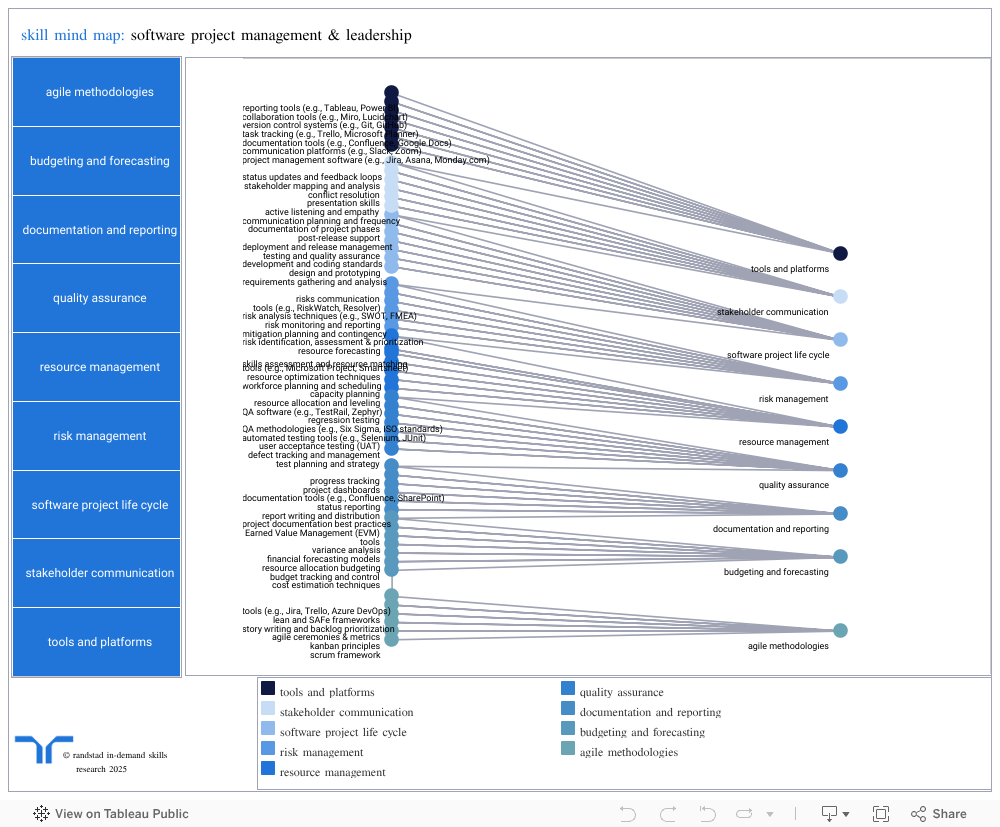
what it shows
The chart here illustrates the sub-level of learned skills required for software project management and leadership in each of the 24 markets researched. The findings presented here are based on a combination of verified, normalized labor market data by market and granular, skill-based data sourced from professional social media networks and job boards, as well as career sites.
need to know
- The software project management and leadership skill cluster includes technical and leadership skills applicable to various roles and seniority levels.
- Some of the most popular sub-skills in this cluster include initiating and maintaining efficiency standards, quality assurance and project management methodologies.
- Success in this skill cluster is rooted in stakeholder management and communications, including presentation skills, conflict resolution and communication planning.
skills supply
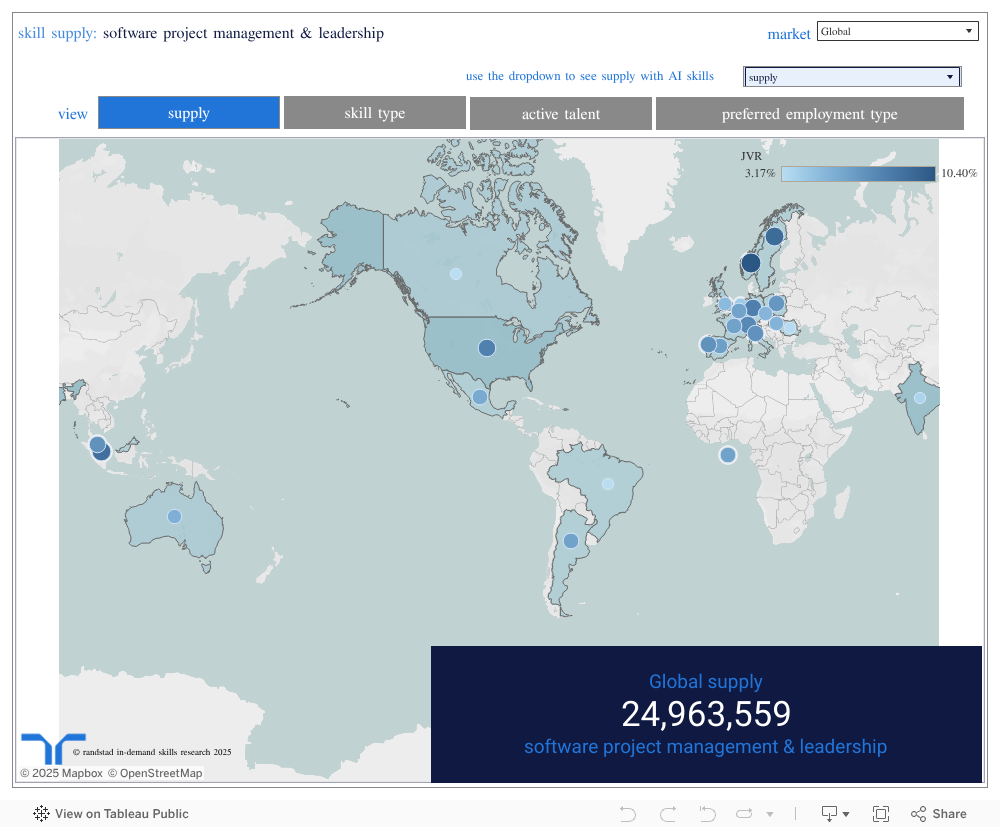
what it shows
Skills supply data indicates the total number of individuals who have the skills required for software project management and leadership in each of the 24 markets researched. These figures are based on a combination of verified, normalized labor market data by market and granular, skill-based data sourced from professional social media networks and job boards, as well as career sites.
Use the chart to understand the availability of skills (“supply map”), availability of sub-skills (“skill type”), talent with recent job search activity (“active talent”), as well as the share of talent who prefer permanent or contract work (“preferred employment type”).
need to know
- The supply of talent for the software project management and leadership skill cluster is one of the biggest, although year-over-year growth is slow. As the majority of talent in the cluster already have a significant share of experience, the influx of new talent is minimal.
- Mobility within the cluster is moderate but consistent, with 13.7% of professionals changing jobs year over year. At 64.4%, openness to pursue new jobs is the second-highest of all clusters, likely in response to fluctuations of the IT space.
- Talent with AI skills in this cluster see the highest mobility boost — about a 30% higher share of people change jobs if they have AI skills.
skills demand
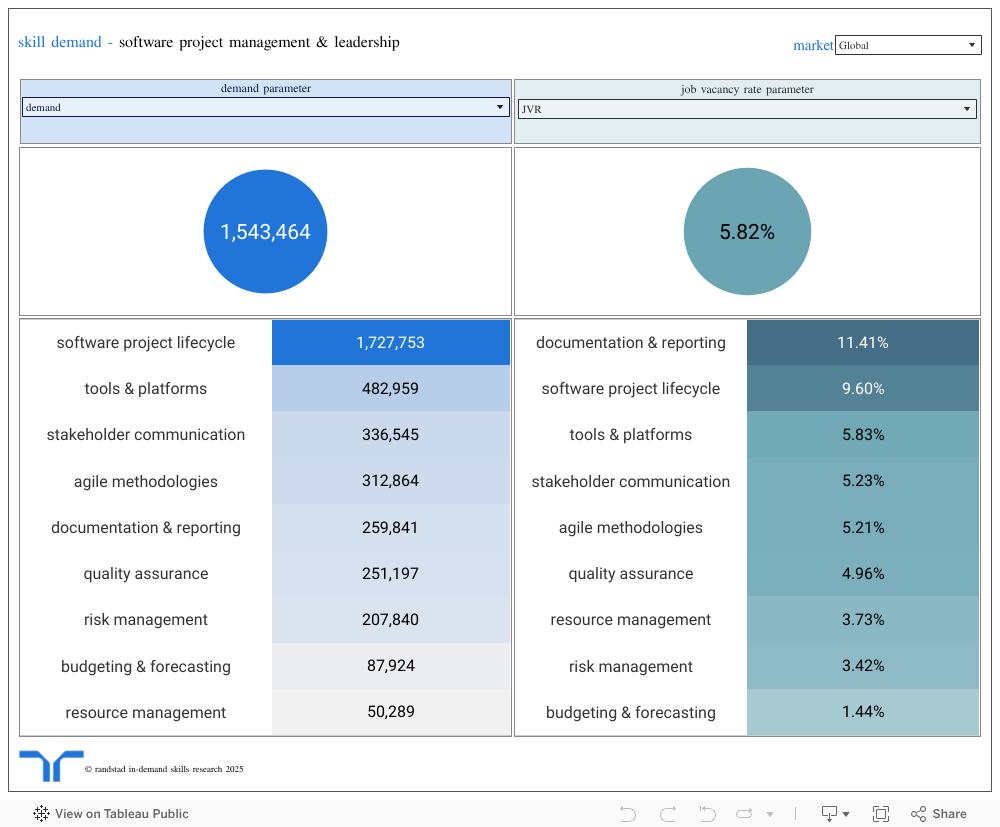
what it shows
Skills demand data indicates job postings that require software project management and leadership skills in each of the 24 markets we researched. These figures are based on a combination of verified, normalized labor market data by market and granular, skill-based data sourced from professional social media networks, job boards and career sites.
See demand for each skill cluster by market, explore demand for sub-skills within each cluster or view the job vacancy ratio (JVR) — defined as hiring complexity — to understand market competitiveness for these skills. The higher the JVR, the more competitive it is to recruit. 2025 demand data takes all yearly advertisements into account.
need to know
- The absolute number of job postings for software developers has dropped by almost 8%, and total hiring complexity for the skill cluster is at 5.8%, placing it within the lower end of all in-demand categories.
- Markets with the most notable hiring complexities include Norway, Sweden and Singapore (all with JVRs above 9%), while Brazil, Canada and Romania have the lowest JVRs (each below 4%).
- Individual sub-skills show a major mismatch between demand and supply around stakeholder communication, life cycle management, and documentation and reporting. Some of the highest JVRs in regard to AI skills are in Switzerland, due to employers’ focus on AI-supported quality assurance.
compensation
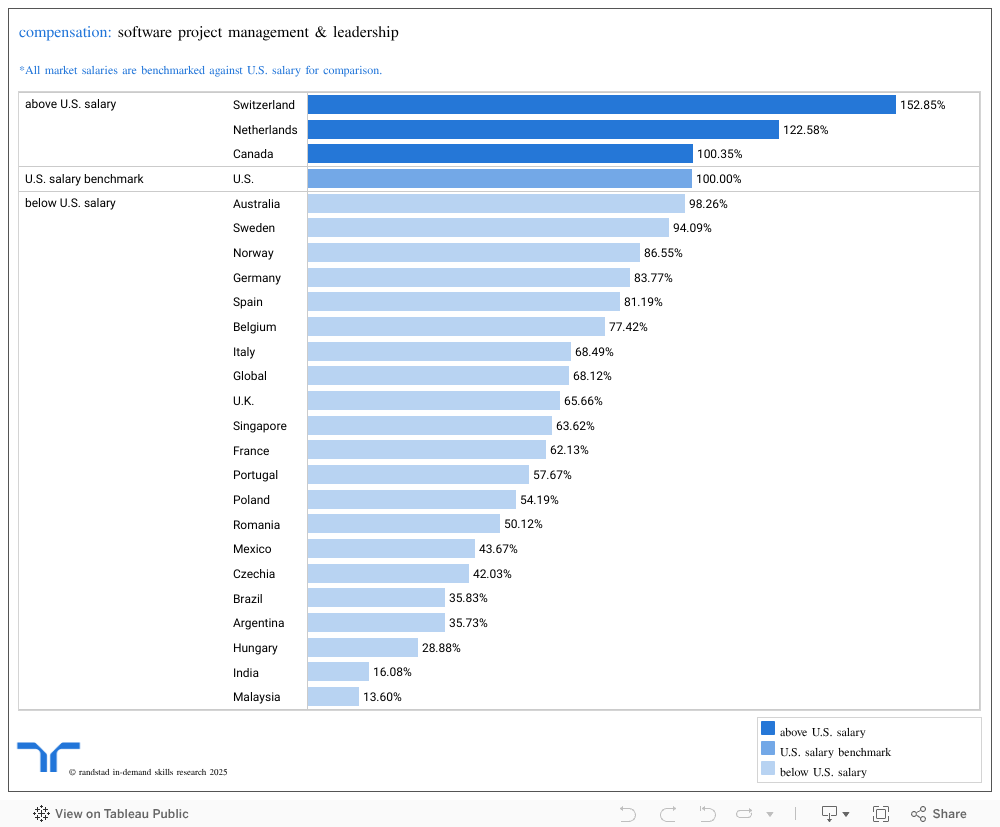
what it shows
The data included in this graph shows the average salary brackets in U.S. dollars for software project management and leadership skills in the 24 markets examined by level. Compensation data is mapped and analyzed from combined sources providing current pay data.
Select the markets of interest to understand which salary ranges are considered competitive and in which markets you should recruit to stay within budget.
need to know
- Compensation for software project management and leadership roles has generally risen across the board, with the highest increases in APAC (up 9%).
- Despite reduced demand, the general complexity of roles and requirements for this skill cluster is rising. Considering the seniority levels of this cluster, there is rarely any downtrend.
remote & hybrid working
what it shows
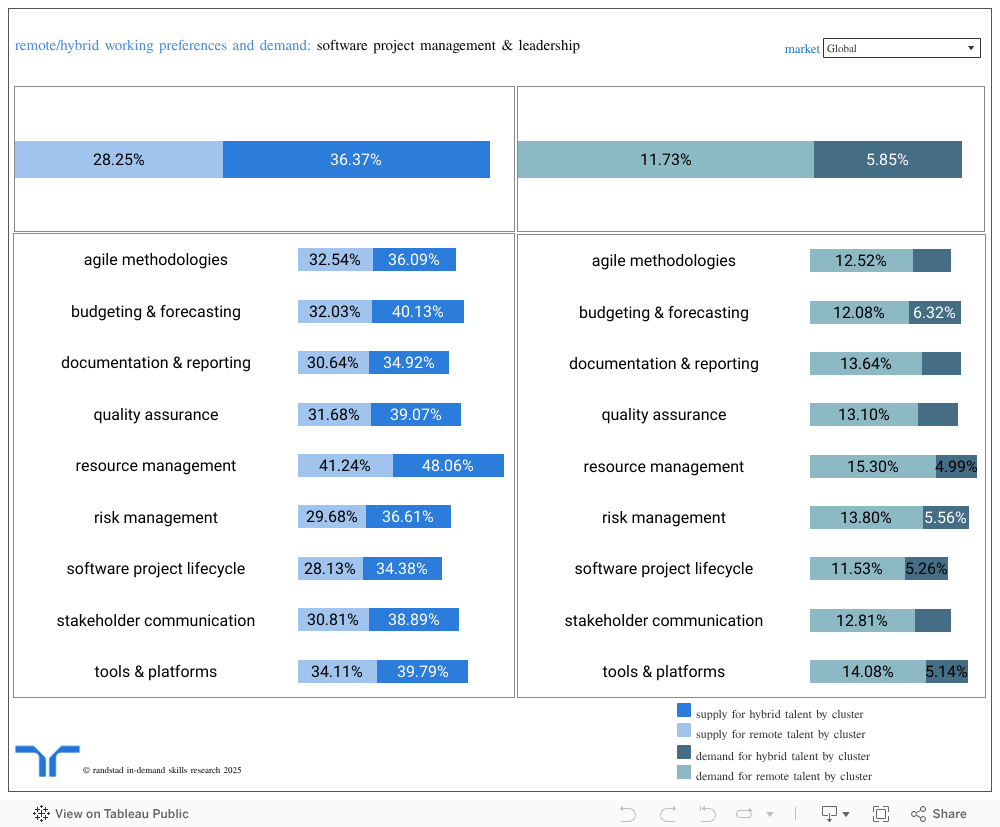
Remote working data shows the percentage of job postings that offer candidates remote or hybrid work for software project management and leadership roles (noted as “demand”), as well as talent working preferences (noted as “supply”) in each of the 24 markets researched.
It is estimated that the actual share of remote/hybrid working opportunities is higher than advertised online. You can view the data by both skill cluster and individual skills.
need to know
- The software project management and leadership cluster has a high share of talent working or preferring to work remotely. Overall preferences have changed year over year (an increase of 20%); however, this is relatively small growth compared to other tech-focused clusters.
- The number of job ads highlighting fully remote work has doubled year over year, while those for hybrid roles has dropped by half.
- The highest share of remote demand is found in markets that have been traditional offshoring hubs, like Poland, Hungary, Czechia and Romania. Interestingly, markets with some of the highest hiring complexity have the lowest share of remote job ads.
take a deep dive into the in-demand skills research and find your competitive talent advantage.