choose a skill cluster

skills & motivations
This section provides a breakdown of the inherent skills, learned skills and motivations/aspirations for each skill cluster. Inherent skills and motivations/aspirations combined are commonly defined as “soft skills” in the market.
inherent skills
- 1. complex problem solving
- 2. logical and analytical thinking
- 3. mathematical aptitude
- 4. curiosity and inquisitiveness
- 5. creativity and innovation
- 6. attention to detail
- 7. interest in technology
- 8. persistence and determination
- 9. spatial reasoning
- 10. collaboration
- 11. ethical awareness
learned skills
- 1. machine learning
- 2. robotics
- 3. AI frameworks and libraries
- 4. natural language processing
- 5. computer vision
- 6. AI infrastructure and tools
- 7. automation tools and platforms
- 8. ethics and compliance
motivations/aspirations
- 1. technological innovation
- 2. problem-solving and intellectual stimulation
- 3. societal/industrial impact
- 4. financial incentives
- 5. career advancement
- 6. research/academic engagement
- 7. entrepreneurial prospects
- 8. ethical considerations
- 9. global collaboration
- 10. continuous learning and skill development
- 11. creative expression
- 12. contribution to sustainability
- 13. work-life balance
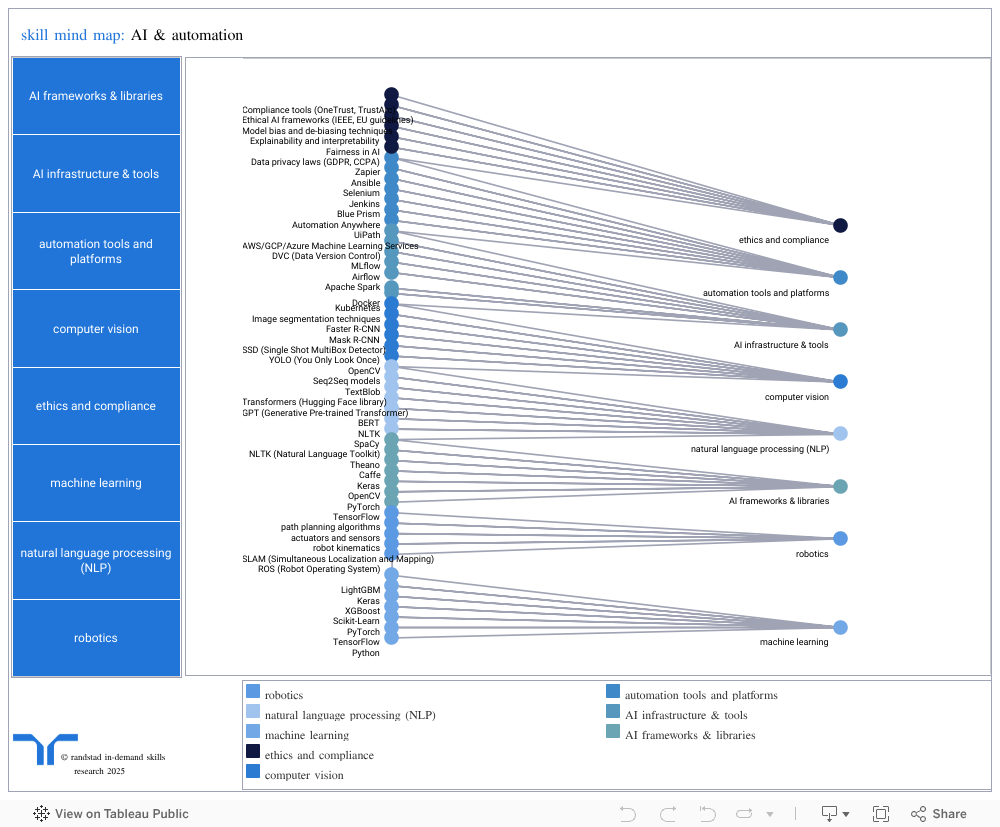
what it shows
The chart here illustrates the sub-level of learned skills required for AI and automation in each of the 24 markets researched. The findings presented here are based on a combination of verified, normalized labor market data by market and granular, skill-based data sourced from professional social media networks and job boards, as well as career sites.
need to know
- All tech skill clusters share a significant portion of sub-skills, although the AI skill cluster remains unique in terms of how those skills are applied.
- Some of the most recurring sub-skills include applied machine learning, Python and deep learning.
- Python, PyTorch and Tensorflow are some of the most common skill combinations for modern AI profiles.
skills supply
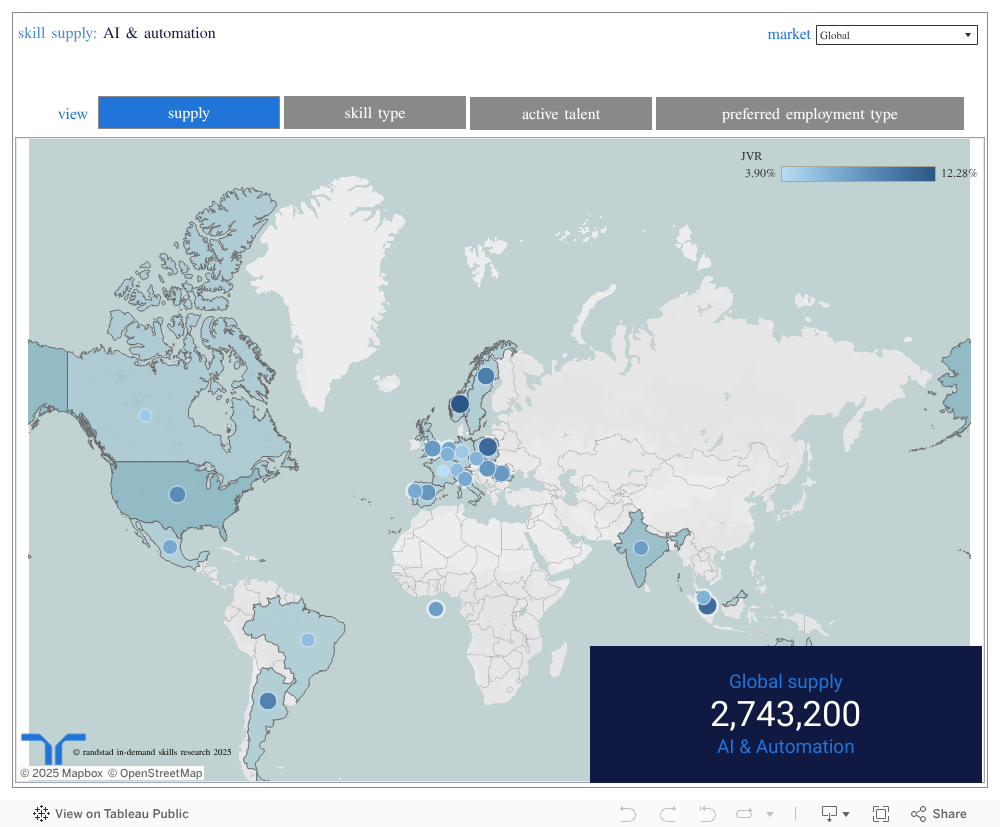
what it shows
Skills supply data indicates the total number of individuals who have the skills required for AI and automation in each of the 24 markets researched. These figures are based on a combination of verified, normalized labor market data by market and granular, skill-based data sourced from professional social media networks and job boards, as well as career sites.
Use the chart to understand the availability of skills (“supply map”), availability of sub-skills (“skill type”), talent with recent job search activity (“active talent”), as well as the share of talent who prefer permanent or contract work (“preferred employment type”).
need to know
- Talent supply has grown 3.7% this year — the fastest increase of any cluster and an acceleration from last year’s steady gains.
- AI and automation remains the skill cluster with the highest talent mobility rate; 19.0% of professionals have changed jobs since last year, up slightly from 2024.
- Contract work has nearly doubled since last year, indicating increased flexibility and demand for project-based expertise.
- Despite supply growth, senior-level professionals remain in short supply, keeping hiring complexity high across most markets.
skills demand
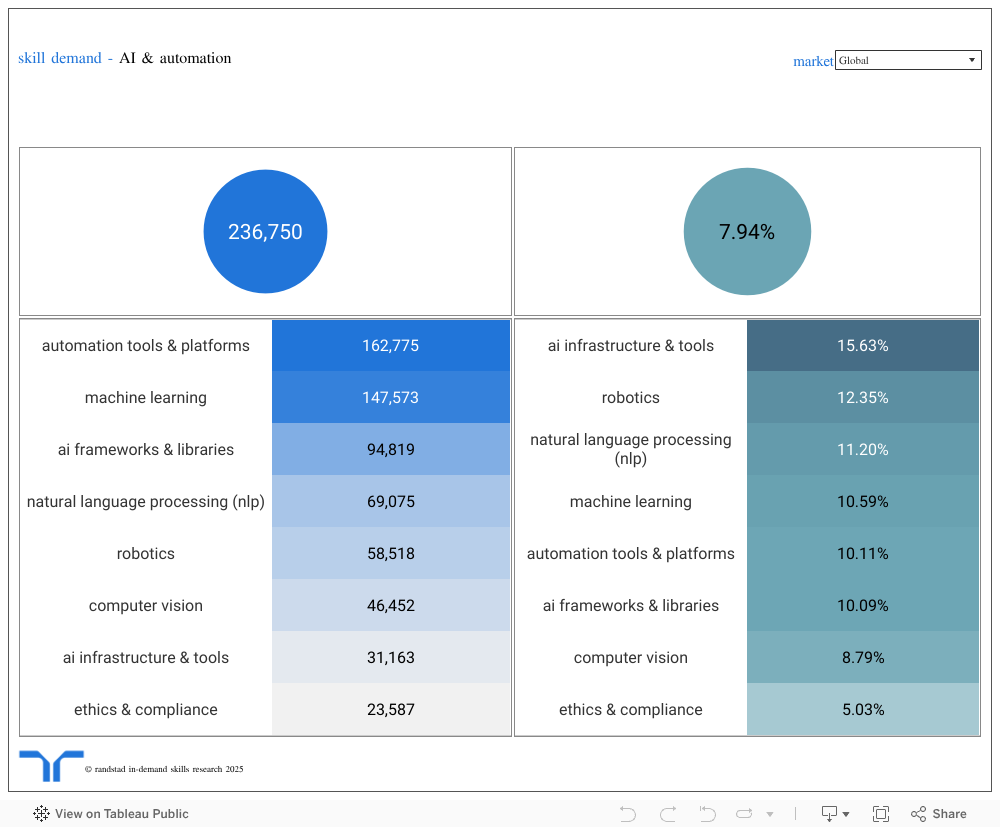
what it shows
Skills demand data indicates job postings that require AI and automation skills in each of the 24 markets we researched. These figures are based on a combination of verified, normalized labor market data by market and granular, skill-based data sourced from professional social media networks, job boards and career sites.
See demand for each skill cluster by market, explore demand for sub-skills within each cluster or view the job vacancy ratio (JVR) — defined as hiring complexity — to understand market competitiveness for these skills. The higher the JVR, the more competitive it is to recruit. 2025 demand data takes all yearly advertisements into account.
need to know
- Demand has increased 39.6% year over year — the strongest of any cluster and up from modest growth in 2024.
- AI infrastructure and tools remain the hardest sub-skills to fill, with average JVRs of 15.7%.
- Senior-level talent remains scarce, with hiring complexity averaging around 16% JVR.
- Markets with the highest hiring complexities include Norway, Romania, Spain and Singapore.
compensation
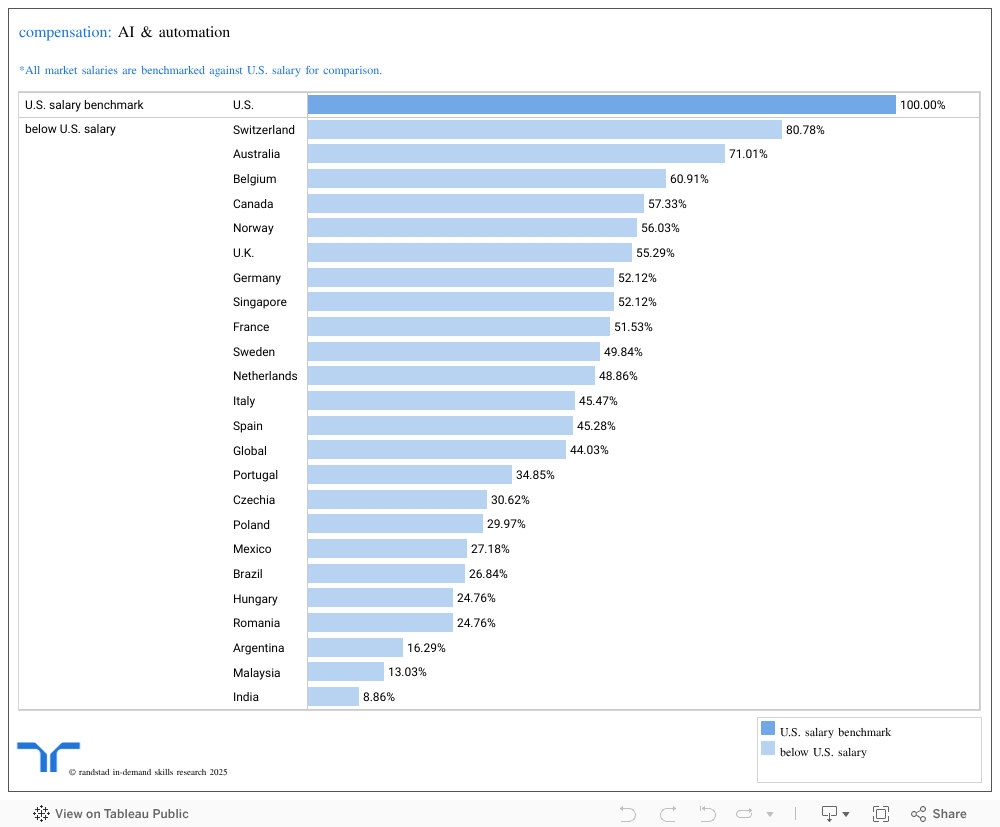
what it shows
The data included in this graph shows the average salary brackets in U.S. dollars for AI and automation skills in the 24 markets examined by level. Compensation data is mapped and analyzed from combined sources providing current pay data.
Select the markets of interest to understand which salary ranges are considered competitive and in which markets you should recruit to stay within budget.
need to know
- Compensation continues to rise globally — up 9.8% year over year in EMEA and 2.5% in the U.S., a steady increase from last year’s pace.
- The U.S. remains the highest-paying market, while India and Malaysia continue to trail with lower averages due to lower labor costs.
- Salary growth reflects heightened demand for senior AI specialists and cross-functional expertise.
remote & hybrid working
what it shows
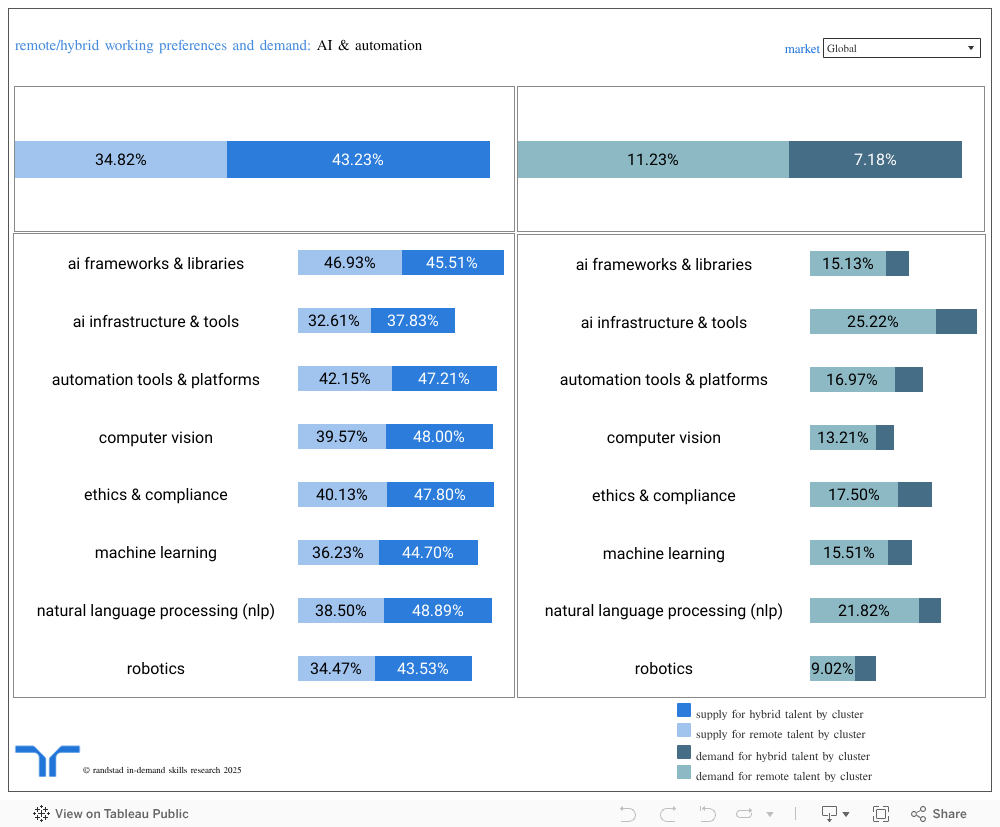
Remote working data shows the percentage of job postings that offer candidates remote or hybrid work for AI and automation roles (noted as “demand”), as well as talent working preferences (noted as “supply”) in each of the 24 markets researched.
It is estimated that the actual share of remote/hybrid working opportunities is higher than advertised online. You can view the data by both skill cluster and individual skills.
need to know
- AI and automation roles remain among the most remote-enabled, with little year-over-year change in remote or hybrid shares.
- Talent preferences for flexible work have doubled, with more professionals seeking or working in hybrid or remote models (34.8% remote, 43.2% hybrid).
- Remote demand is highest in the U.S. (18.2%), Czechia (15.8%), Portugal (15.4%) and Poland (13.3%), driven by outsourcing markets supporting larger economies.
take a deep dive into the in-demand skills research and find your competitive talent advantage.