explore by skill cluster

check out highlights from the global findings.
in-demand skills overview
need to know
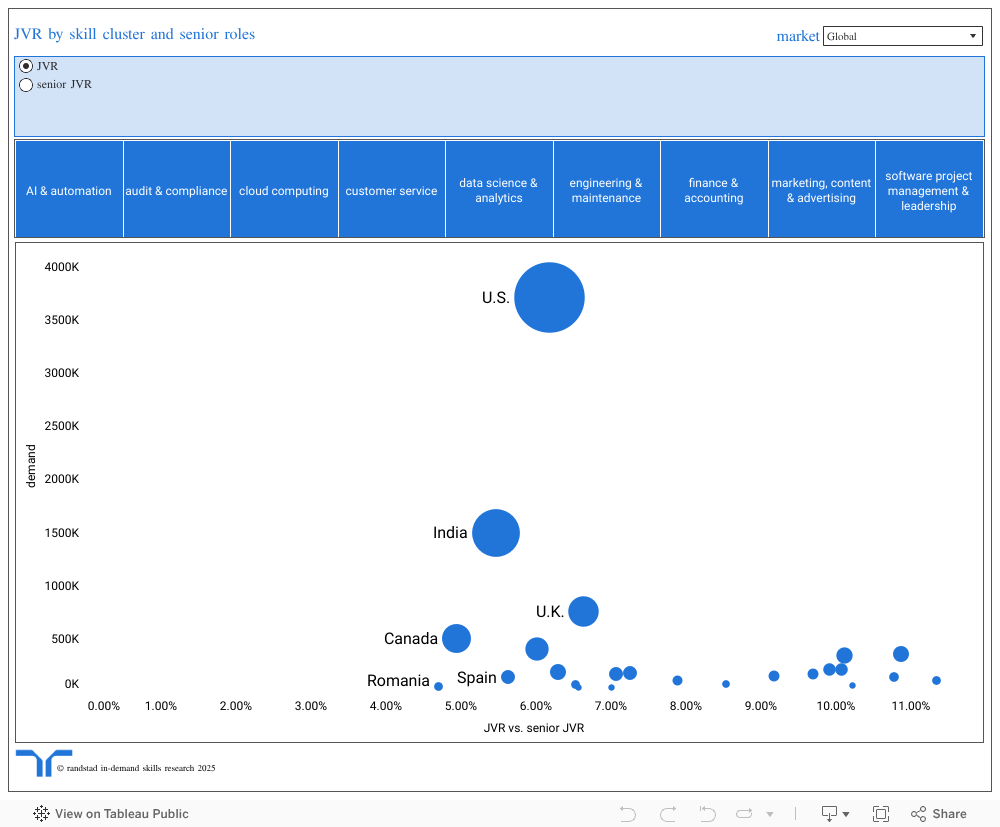
The data shown here (and in the charts that follow below) represents information from millions of talent profiles, CVs and job advertisements across 24 markets. This chart provides a combined view of data from more than 22 million job postings and 166 million CVs, aligning with the top white-collar in-demand skill clusters.
The interactive visualization here represents the job vacancy rate (x-axis) and demand (y-axis) of skills. Use the blue navigation at the top of the chart to select a specific skill cluster, then hover over each market to see details on talent supply. You can explore supply and demand data by market, with the ability to see how experience level impacts hiring complexity.
learned skills overview
need to know
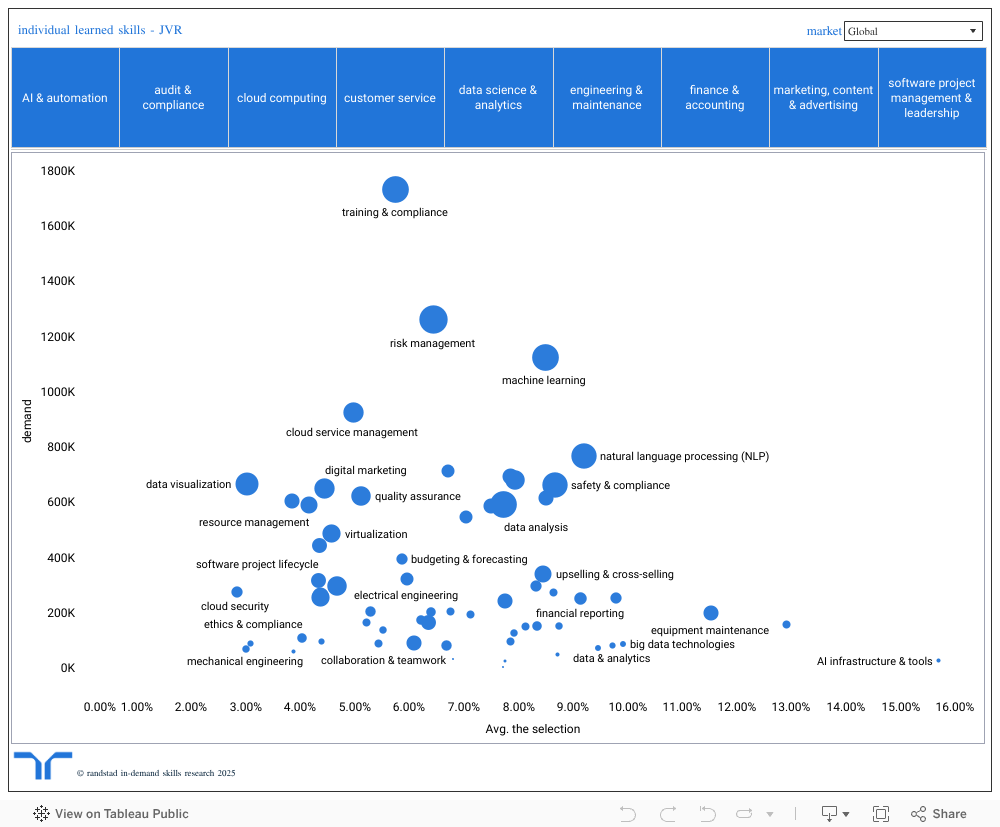
The interactive visualization here represents the job vacancy rate (x-axis) and demand (y-axis) of specific learned sub-skills for each of the nine white-collar skill clusters. Use the blue navigation at the top of the chart to select a specific skill cluster, then hover over individual skills to see details on talent supply. You can filter the data by geographic market using the drop-down option at the top right corner of the chart.
inherent skills overview
need to know
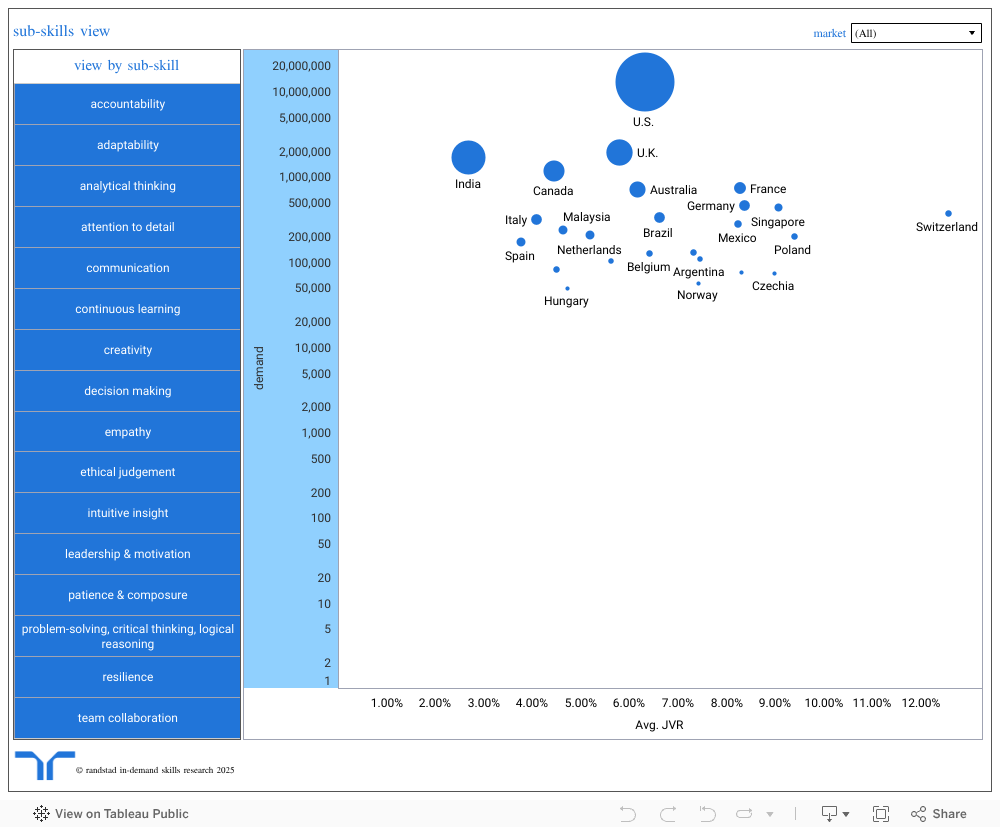
The interactive visualization here represents the job vacancy rate (x-axis) and demand (y-axis) of common inherent skills that are needed for the 2025 white-collar in-demand skill clusters. Use the blue navigation on the left side of the chart to select a specific inherent skill, then hover over individual markets to see details on talent supply.
about the in-demand skills research
-
what is it?
Conducted by our Talent Intelligence team, Randstad Enterprise’s Global In-demand Skills research aggregates, normalizes and analyzes global employment data from multiple sources and across five dimensions to uncover which professional skills are seeing the highest demand. As part of the 2025 research, we analyzed over 22 million job postings and 166 million CVs assessed on a skill level and over 380 million on meta-data level. This data is tracked and assessed over the course of a full year.
To help you better understand actual talent supply, the research also includes filters that allow you to see how adding AI skills or specifying seniority levels impact hiring complexity across markets. That means, you will be able to see how challenging it may be to find senior engineering professionals who know how to advance their work using AI tools.
-
how do I use the research?
Employers can use this market intelligence to drive smarter decisions about how, when and where they hire; which skills they’ll need to develop internally; whether they should focus on senior- or junior-level talent, and how decisions like remote working policies can impact retention. You can explore hiring complexity data using the global charts on this page, or dive deeper into each skill cluster using the drop-down option on the top of the page to learn more about supply and demand, talent mobility, compensation, sub-skills needed, and remote working preferences.
-
what’s new in this release?
While in previous years the Global In-demand Skills research has been collected and analyzed over the course of two quarters –providing a snapshot of trends — our 2025 research represents data monitored and actively analyzed over the course of a full year. This provides a more accurate view of the global and local talent supply and demand — providing a more relevant long-term analysis of the market landscape.
-
what are the 2025 in-demand skills?
The 2025 Global In-demand Skills Research confirms that, while the levels of demand have changed over recent years, the top high-demand clusters remain unchanged. These include nine white-collar skill clusters (traditionally office-based, non-manual) and four skilled trade families (typically non-office-setting or manual roles) that are challenging to hire for in 24 markets. Distinctions are made in this research for clarification purposes, as job vacancy rates for skilled trades are contextualized differently.
top white-collar skill clusters
- AI & automation
- audit & compliance
- cloud computing
- customer service
- data science & analytics
- engineering & maintenance
- finance & accounting
- marketing, content & advertising
- software project management & leadership
top skilled trades
- maintenance & repair
- manufacturing & plant operations
- nursing & medical care
- retail & direct sales
want more in-demand skills intelligence for your organization?