choose a skill cluster

skills & motivations
This section provides a breakdown of the inherent skills, learned skills and motivations/aspirations for each skill cluster. Inherent skills and motivations/aspirations combined are commonly defined as “soft skills” in the market.
inherent skills
- 1. communication and persuasion
- 2. creativity and innovation
- 3. analytical skills
- 4. strategic thinking
- 5. organizational skills
- 6. adaptability
- 7. learning agility
- 8. broad scanning
- 9. observing and curiosity about people and relationships
- 10. empathy
- 11. experimentation
- 12. big picture perspective
learned skills
- 1. product marketing
- 2. advertising
- 3. content creation
- 4. data and analytics
- 5. digital marketing
- 6. tools and platforms
- 7. brand management
motivations/aspirations
- 1. understanding people, trends and pop culture
- 2. creativity and innovation
- 3. understanding consumer behavior
- 4. financial rewards and incentives
- 5. career advancement and development
- 6. impact on business success
- 7. working with brands and products they believe in
- 8. collaboration and teamwork
- 9. technology and digital engagement
- 10. networking and relationship building
- 11. competitive nature of the field
- 12. opportunity to influence people and persuade
- 13. global reach and cultural engagement
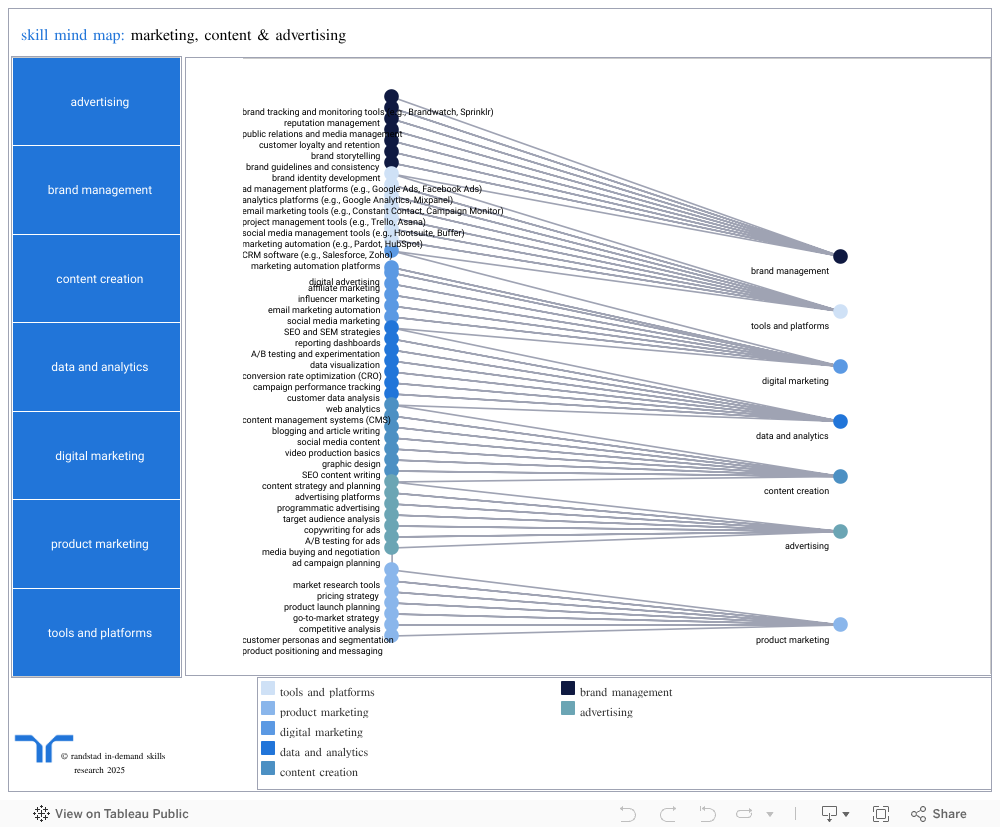
what it shows
The chart here illustrates the sub-level of learned skills required for marketing, content and advertising in each of the 24 markets researched. The findings presented here are based on a combination of verified, normalized labor market data by market and granular, skill-based data sourced from professional social media networks and job boards, as well as career sites.
need to know
- The most valuable marketing talent now unites human insight with AI-driven personalization — delivering the authenticity, agility and measurable impact that keep brands connected to audiences in a rapidly changing world.
- Technology and analytics skills have played an increasingly prominent role in the marketing skill cluster year over year, with a significant share of jobs emphasizing their importance.
skills supply
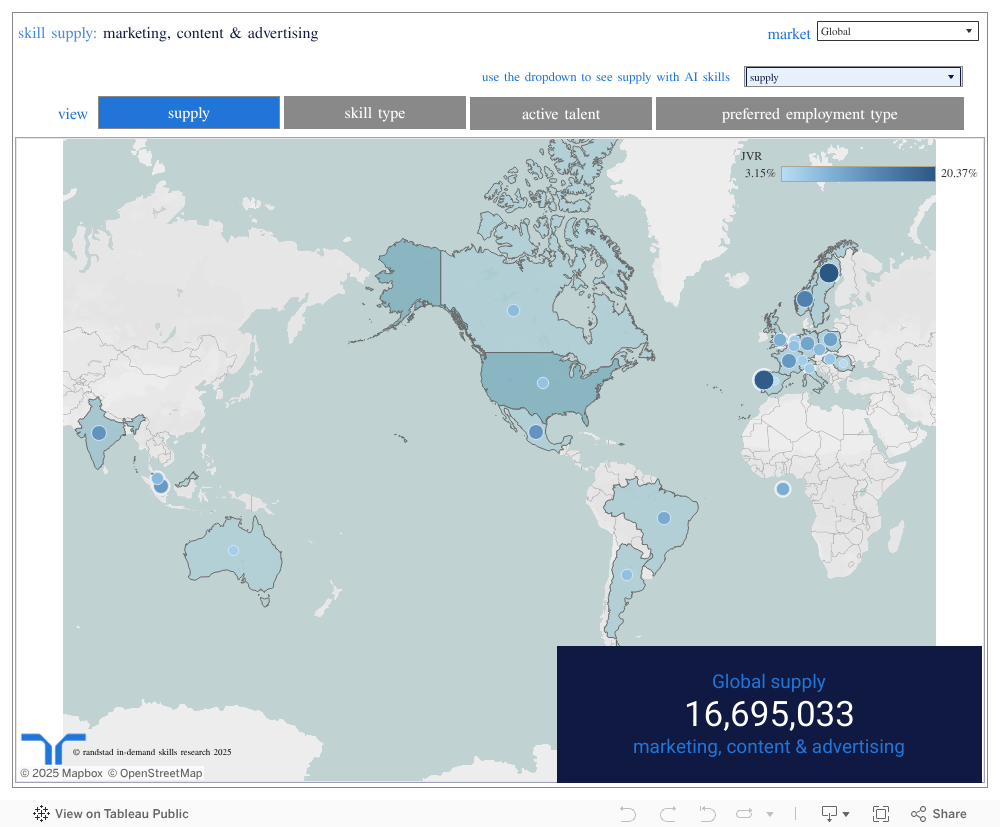
what it shows
Skills supply data indicates the total number of individuals who have the skills required for marketing, content and advertising in each of the 24 markets researched. These figures are based on a combination of verified, normalized labor market data by market and granular, skill-based data sourced from professional social media networks and job boards, as well as career sites.
Use the chart to understand the availability of skills (“supply map”), availability of sub-skills (“skill type”), talent with recent job search activity (“active talent”), as well as the share of talent who prefer permanent or contract work (“preferred employment type”).
need to know
- Talent supply has grown a modest 0.9% year over year, a slowdown from the double-digit gains seen in 2024.
- About 15% of professionals are new to the field, maintaining a healthy pipeline of early-career entrants.
- AI adoption is accelerating, with 5.0% of job ads now referencing AI and 5.7% of professionals reporting AI experience, signaling growing demand for technical fluency.
- Talent mobility remains stable at 16%, while 43% of professionals are actively exploring new opportunities, consistent with 2024 findings.
skills demand
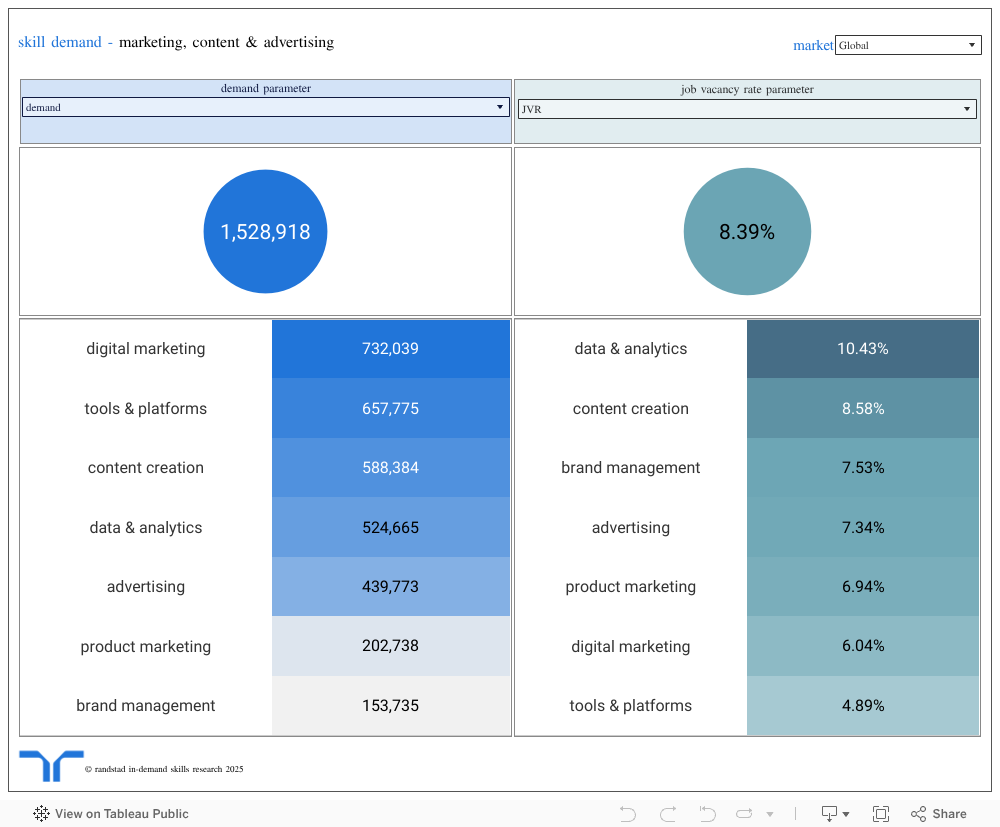
what it shows
Skills demand data indicates job postings that require marketing, content and advertising skills in each of the 24 markets we researched. These figures are based on a combination of verified, normalized labor market data by market and granular, skill-based data sourced from professional social media networks, job boards and career sites.
See demand for each skill cluster by market, explore demand for sub-skills within each cluster or view the job vacancy ratio (JVR) — defined as hiring complexity — to understand market competitiveness for these skills. The higher the JVR, the more competitive it is to recruit. 2025 demand data takes all yearly advertisements into account.
need to know
- Demand for marketing talent has fallen 18% year over year, marking the steepest decline across all clusters amid continued market correction.
- Hiring complexity remains moderate, with JVRs between 12–20% in competitive markets such as Sweden, Portugal, Norway and India.
- Data analytics, brand management and digital marketing are the hardest sub-skills to fill, while entry-level roles (0–2 years of experience) account for over 37% of postings.
- Employers are increasingly seeking marketing professionals with AI and data integration capabilities to maximize automation and ROI.
compensation
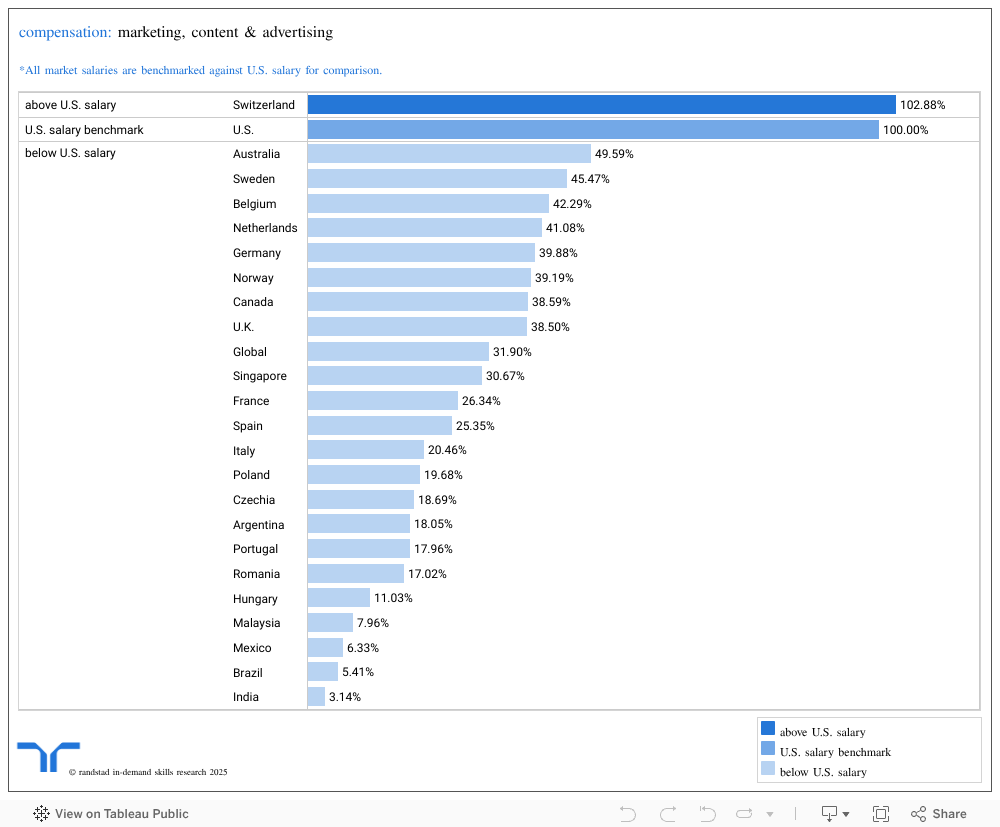
what it shows
The data included in this graph shows the average salary brackets in U.S. dollars for marketing, content and advertising skills in the 24 markets examined by level. Compensation data is mapped and analyzed from combined sources providing current pay data.
Select the markets of interest to understand which salary ranges are considered competitive and in which markets you should recruit to stay within budget.
need to know
- Global compensation has risen modestly in 2025 — up 4% in the U.S., but down 1.3% in EMEA, reflecting uneven regional trends.
- Compensation remains above national averages despite softer demand. This is supported by rising role complexity and growing demand for analytical and technical skills.
- Offshoring markets, such as Mexico and Poland, continue to report the fastest wage growth, consistent with last year’s trends.
remote & hybrid working
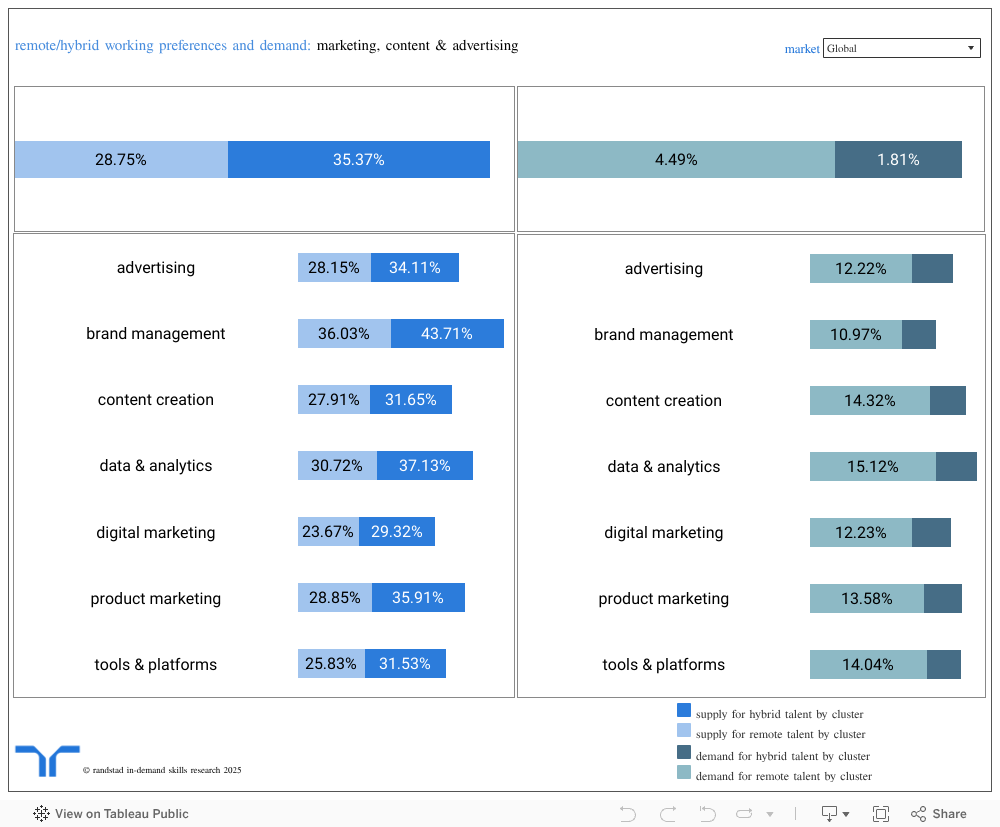
what it shows
Remote working data shows the percentage of job postings that offer candidates remote or hybrid work for marketing, content and advertising roles (noted as “demand”), as well as talent working preferences (noted as “supply”) in each of the 24 markets researched.
It is estimated that the actual share of remote/hybrid working opportunities is higher than advertised online. You can view the data by both skill cluster and individual skills.
need to know
- Remote postings have fallen 40% year over year, while hybrid roles have dropped over 80%, marking one of the steepest declines across all skill clusters.
- Marketing is the only skill cluster where talent preferences for remote or hybrid work have also declined (–10.9% and –8.9%, respectively).
- Hungary, Czechia and Poland continue to lead in remote opportunities (over 15%), while Sweden, Norway and India remain below 2%.
take a deep dive into the in-demand skills research and find your competitive talent advantage.