choose a skill cluster

skills & motivations
This section provides a breakdown of the inherent skills, learned skills and motivations/aspirations for each skill cluster. Inherent skills and motivations/aspirations combined are commonly defined as “soft skills” in the market.
inherent skills
- 1. curiosity
- 2. analytical thinking
- 3. mathematical ability
- 4. attention to detail
- 5. creativity
- 6. persistence
- 7. interest in technology
learned skills
- 1. data visualization
- 2. data analysis
- 3. data infrastructure and tools
- 4. machine learning
- 5. domain-specific analytics
- 6. data wrangling
- 7. predictive modeling
- 8. Big Data technologies
motivations/aspirations
- 1. intellectual curiosity
- 2. problem-solving
- 3. impact on decision-making
- 4. innovation and creativity
- 5. collaboration and interdisciplinary work
- 6. financial rewards
- 7. career growth opportunities
- 8. contribution to social good
- 9. technological advancement
- 10. recognition and achievement
- 11. work-life balance
- 12. alignment with organizational goals and values
- 13. entrepreneurial opportunities
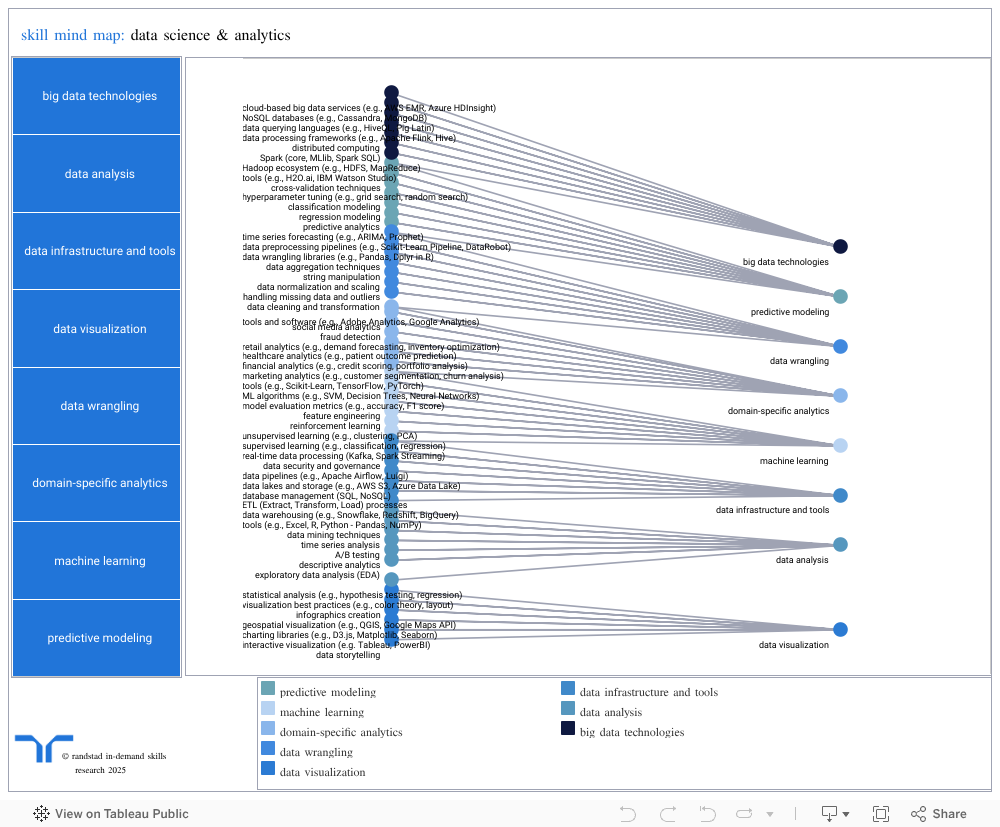
what it shows
The chart here illustrates the sub-level of learned skills required for data science and analytics in each of the 24 markets researched. The findings presented here are based on a combination of verified, normalized labor market data by market and granular, skill-based data sourced from professional social media networks and job boards, as well as career sites.
need to know
- Data science and analytics is an extremely broad category with a variety of tools and programming languages that can be applied across different tech clusters, making it also one of the most mobile talent pools.
- Experience with Python, expert Excel and visualization skills, and the ability to master Big Data technologies are among the most frequently occurring skills in this cluster.
skills supply
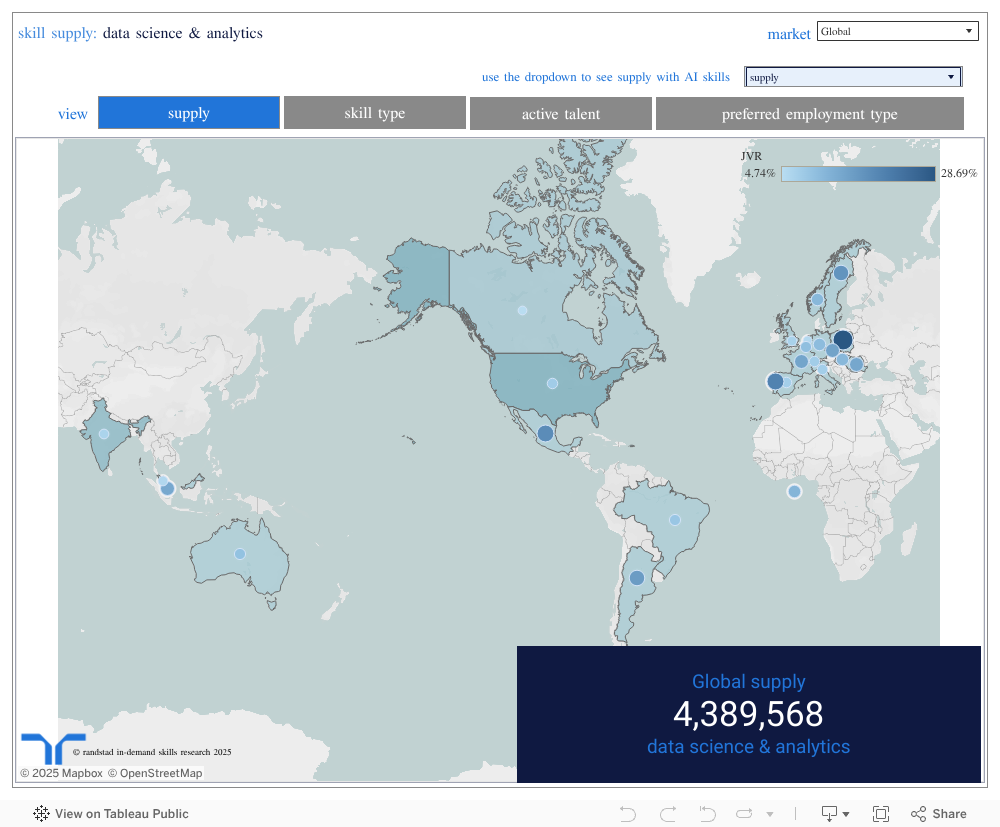
what it shows
Skills supply data indicates the total number of individuals who have the skills required for data science and analytics in each of the 24 markets researched. These figures are based on a combination of verified, normalized labor market data by market and granular, skill-based data sourced from professional social media networks and job boards, as well as career sites.
Use the chart to understand the availability of skills (“supply map”), availability of sub-skills (“skill type”), talent with recent job search activity (“active talent”), as well as the share of talent who prefer permanent or contract work (“preferred employment type”).
need to know
- Talent supply continues to expand, with a 3.1% increase in new entrants, making it the second most popular entry field after AI.
- The cluster remains highly mobile, with 18.0% of professionals changing jobs year over year.
- Over one-quarter (26%) of professionals now possess AI skills, aligning closely with employer demand across job postings.
- Senior professionals are in short supply, driving elevated competition in most markets and increasing reliance on global sourcing.
skills demand
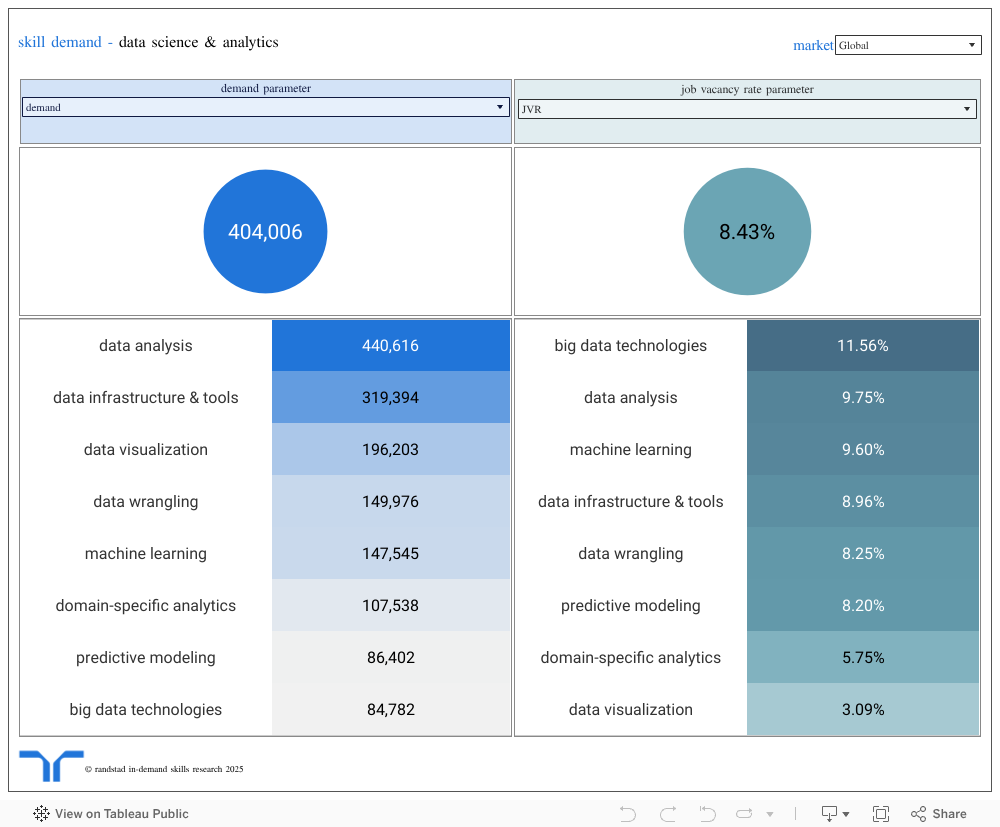
what it shows
Skills demand data indicates job postings that require data science and analytics skills in each of the 24 markets we researched. These figures are based on a combination of verified, normalized labor market data by market and granular, skill-based data sourced from professional social media networks, job boards and career sites.
See demand for each skill cluster by market, explore demand for sub-skills within each cluster or view the job vacancy ratio (JVR) — defined as hiring complexity — to understand market competitiveness for these skills. The higher the JVR, the more competitive it is to recruit. 2025 demand data takes all yearly advertisements into account.
need to know
- Demand for data science and analytics talent remains steady year over year, but it is among the hardest to fill globally, with JVRs for senior roles averaging at 16.9%, and junior roles accounting for only about 17% of postings.
- Predictive modeling, big data and infrastructure tools are the most difficult sub-skills to hire, driving high hiring complexity across markets.
- Local hiring complexity averages at 16.47% JVR, peaking in Poland (28.7%), Portugal (20.6%) and Mexico (18.9%), while globalization and offshoring help reduce pressure elsewhere.
compensation
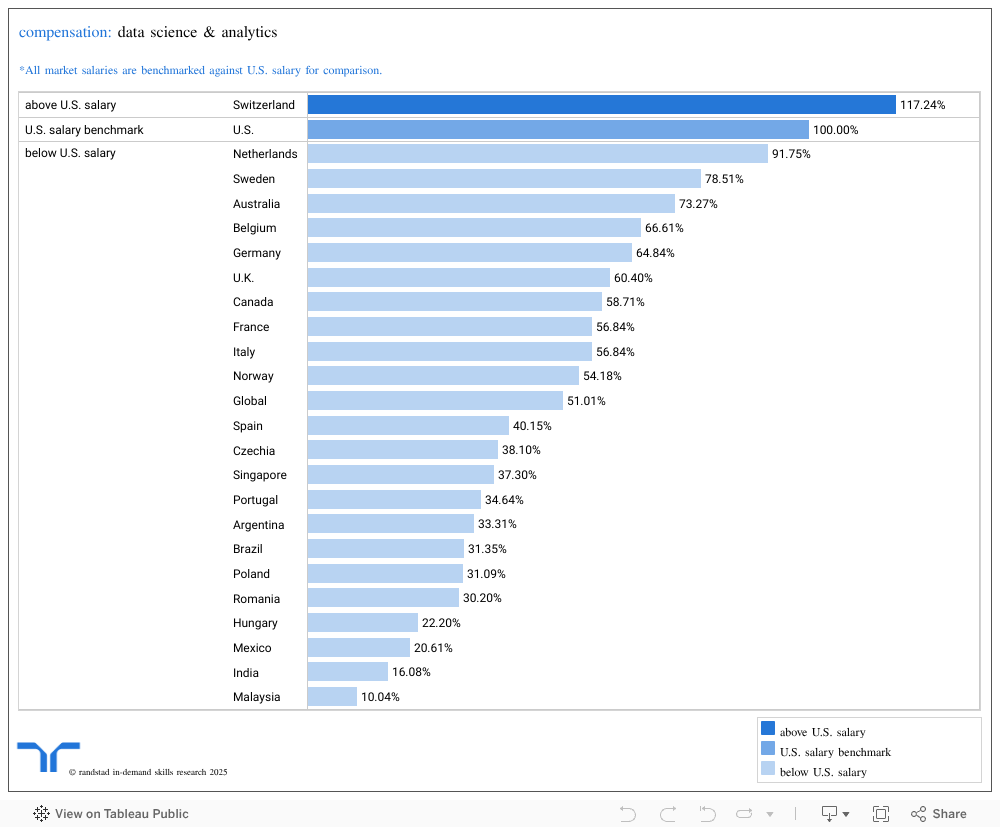
what it shows
The data included in this graph shows the average salary brackets in U.S. dollars for data science and analytics skills in the 24 markets examined by level. Compensation data is mapped and analyzed from combined sources providing current pay data.
Select the markets of interest to understand which salary ranges are considered competitive and in which markets you should recruit to stay within budget.
need to know
- Salaries have grown across most regions — an increase of 8.0% in EMEA and 6.5% in APAC — reflecting high competition for experienced talent.
- Despite slower demand growth, seniority shifts have raised global averages; senior data specialists command premium compensation.
- The U.S. and Switzerland remain the highest-paying markets, while India continues to offer lower salary baselines as data skills grow in demand across clusters.
remote & hybrid working
what it shows
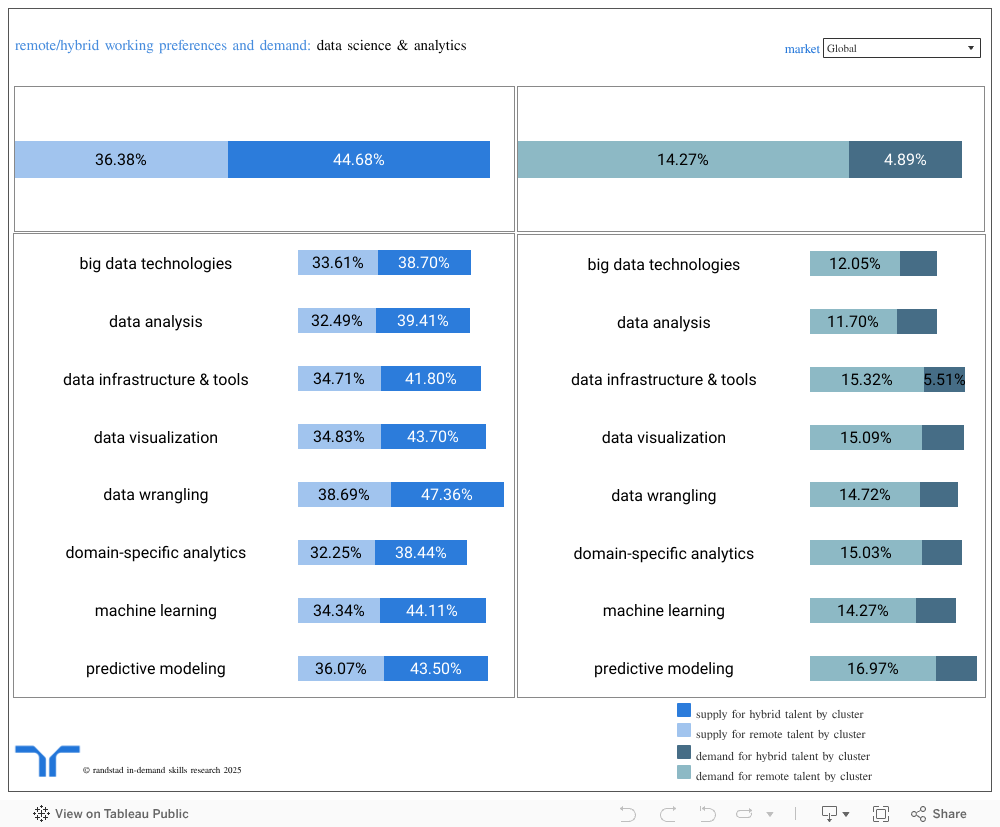
Remote working data shows the percentage of job postings that offer candidates remote or hybrid work for data science and analytics roles (noted as “demand”), as well as talent working preferences (noted as “supply”) in each of the 24 markets researched.
It is estimated that the actual share of remote/hybrid working opportunities is higher than advertised online. You can view the data by both skill cluster and individual skills.
need to know
- Remote opportunities have grown to 14.2% of all postings, up from 8.7% last year. This marks one of the widest shares of remote postings across all skill clusters.
- Hybrid roles have declined slightly as more organizations move data-centric teams to fully remote arrangements.
- Talent preferences for flexible models remain high; 36% work or prefer to work remotely — one of the highest across all clusters.
- Argentina, Poland, Brazil and Czechia lead in remote opportunities (27.0-35.0%), while Singapore, France and Sweden remain the most restrictive (2.7-3.1%).
take a deep dive into the in-demand skills research and find your competitive talent advantage.