choose a skill cluster

skills & motivations
This section provides a breakdown of the inherent skills, learned skills and motivations/aspirations for each skill cluster. Inherent skills and motivations/aspirations combined are commonly defined as “soft skills” in the market.
inherent skills
- 1. communication skills
- 2. empathy
- 3. patience
- 4. problem-solving abilities
- 5. people-oriented
- 6. adaptability
- 7. organizational skills
- 8. composure
- 9. culture sensitivity
- 10. negotiation
- 11. sales skills
learned skills
- 1. collaboration and teamwork
- 2. customer interaction platforms
- 3. documentation and reporting
- 4. feedback collection
- 5. issue resolution
- 6. product/service knowledge
- 7. training and compliance
- 8. upselling and cross-selling
motivations/aspirations
- 1. helping others
- 2. winning negotiations
- 3. professional growth and development
- 4. performance incentives
- 5. company mission and values alignment
- 6. stability and benefits
- 7. social interaction
- 8. challenging work environment
- 9. feedback and recognition
- 10. work-life balance
- 11. building relationships
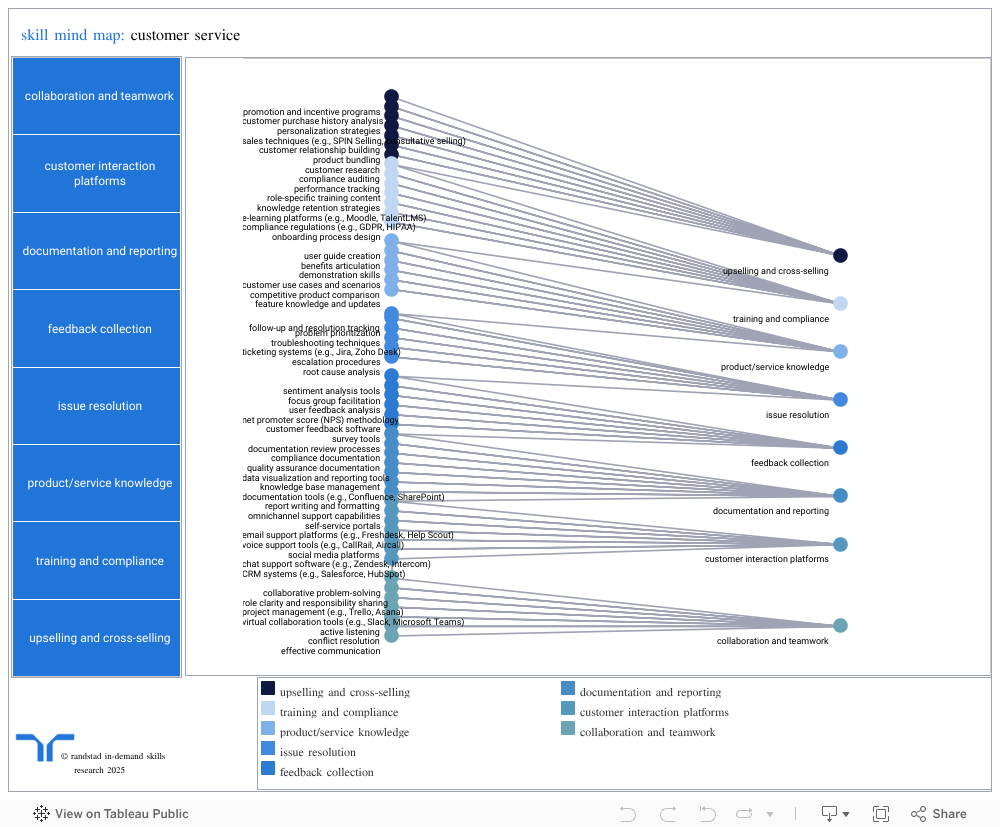
what it shows
The chart here illustrates the sub-level of learned skills required for customer service in each of the 24 markets researched. The findings presented here are based on a combination of verified, normalized labor market data by market and granular, skill-based data sourced from professional social media networks and job boards, as well as career sites.
need to know
- Customer service is a skill cluster with a broad spectrum of skills valued across any type of job, although the core of the skill cluster is within effective communication skills.
- Relationship management and customer satisfaction are some of the most frequently recurring skills across all profiles.
- Customer service roles tend to differ slightly between regions — for example, multilingual capabilities are more in demand in EMEA.
skills supply
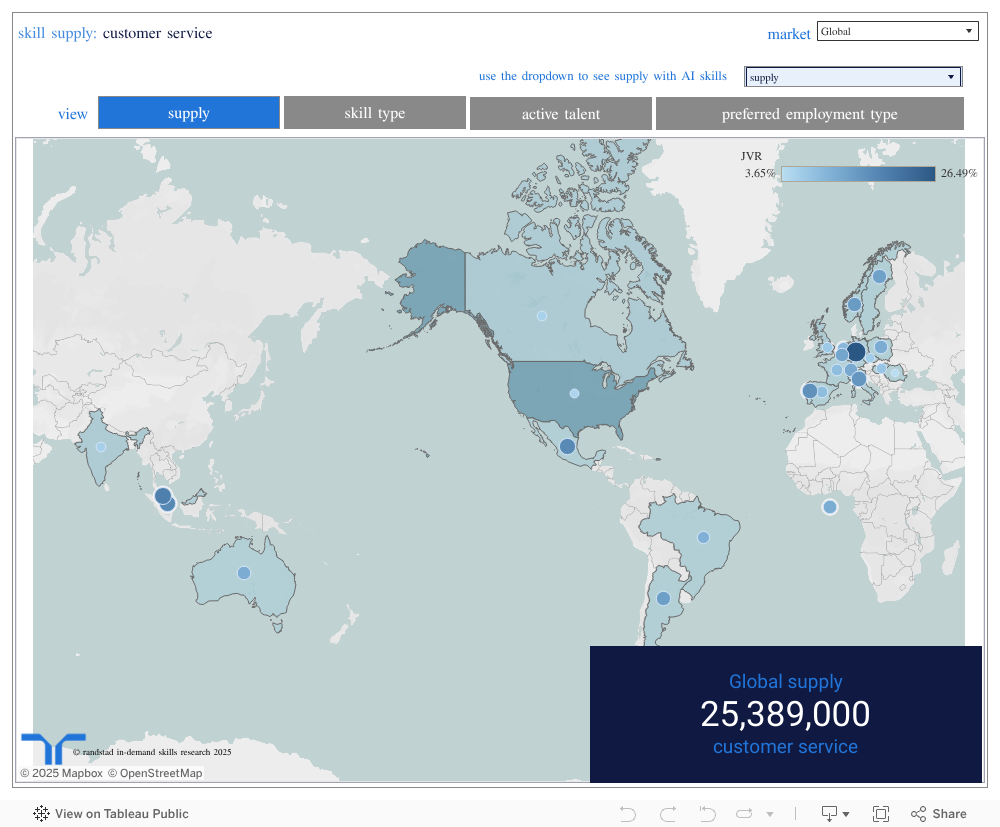
what it shows
Skills supply data indicates the total number of individuals who have the skills required for customer service in each of the 24 markets researched. These figures are based on a combination of verified, normalized labor market data by market and granular, skill-based data sourced from professional social media networks and job boards, as well as career sites.
Use the chart to understand the availability of skills (“supply map”), availability of sub-skills (“skill type”), talent with recent job search activity (“active talent”), as well as the share of talent who prefer permanent or contract work (“preferred employment type”).
need to know
- The supply of talent in the customer service cluster has become relatively low, with 0.4% of its growth coming from fresh talent entering the job market. At the same time, the overall composition of the cluster lends more towards junior talent, as only 38% of talent stay in the category for more than 10 years.
- The cluster also has one of the lowest mobility levels, with only 12.8% of professionals changing jobs in the last year, and 45% saying they are open to a change.
- Mobility increases for talent with AI skills by 34%, as does openness to switching jobs (60%); however, only 2.3% of the talent supply declare AI skills.
skills demand
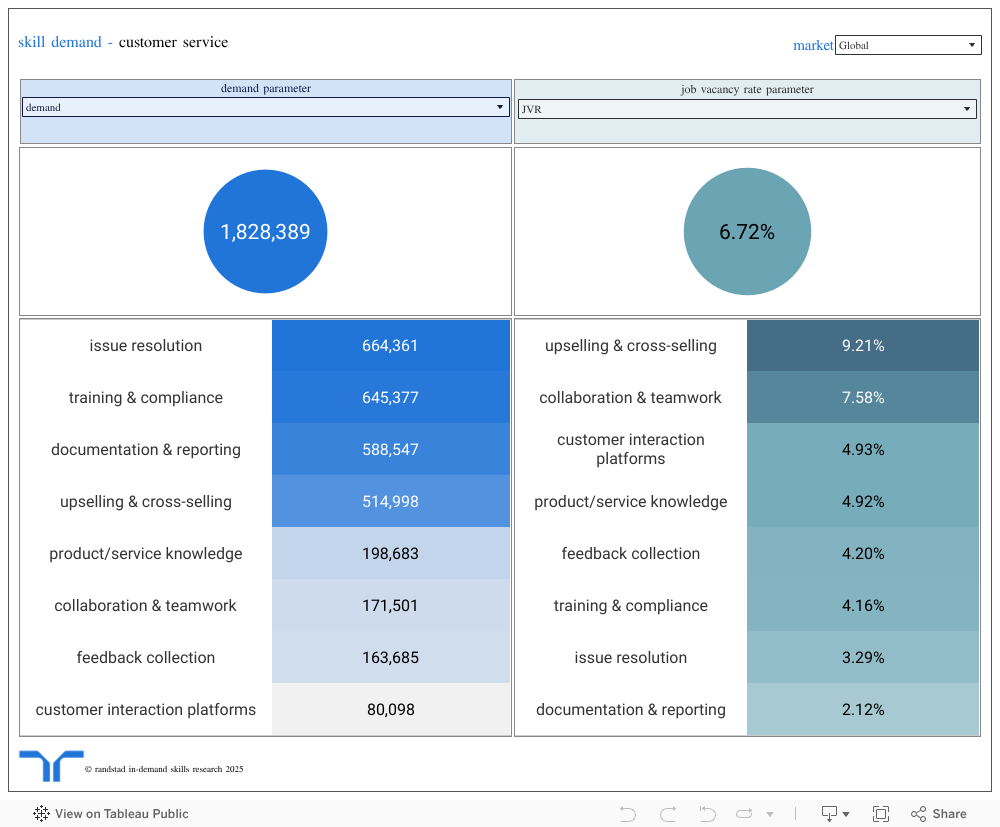
what it shows
Skills demand data indicates job postings that require customer service skills in each of the 24 markets we researched. These figures are based on a combination of verified, normalized labor market data by market and granular, skill-based data sourced from professional social media networks, job boards and career sites.
See demand for each skill cluster by market, explore demand for sub-skills within each cluster or view the job vacancy ratio (JVR) — defined as hiring complexity — to understand market competitiveness for these skills. The higher the JVR, the more competitive it is to recruit. 2025 demand data takes all yearly advertisements into account.
need to know
- Overall demand for traditional customer service roles has decreased by 12%, largely due to the impact — or expectation — of automation. A significant share of this decrease is led by English-speaking markets, which may be attributed to the quality of conversational chatbots.
- The most difficult skills to hire are those related to revenue generation, like up-selling and cross-selling, which can have JVRs above 15%.
- More than 63% of job ads throughout the year required experience between 0 and 2 years, showing how much employers rely on younger and part-time talent.
compensation
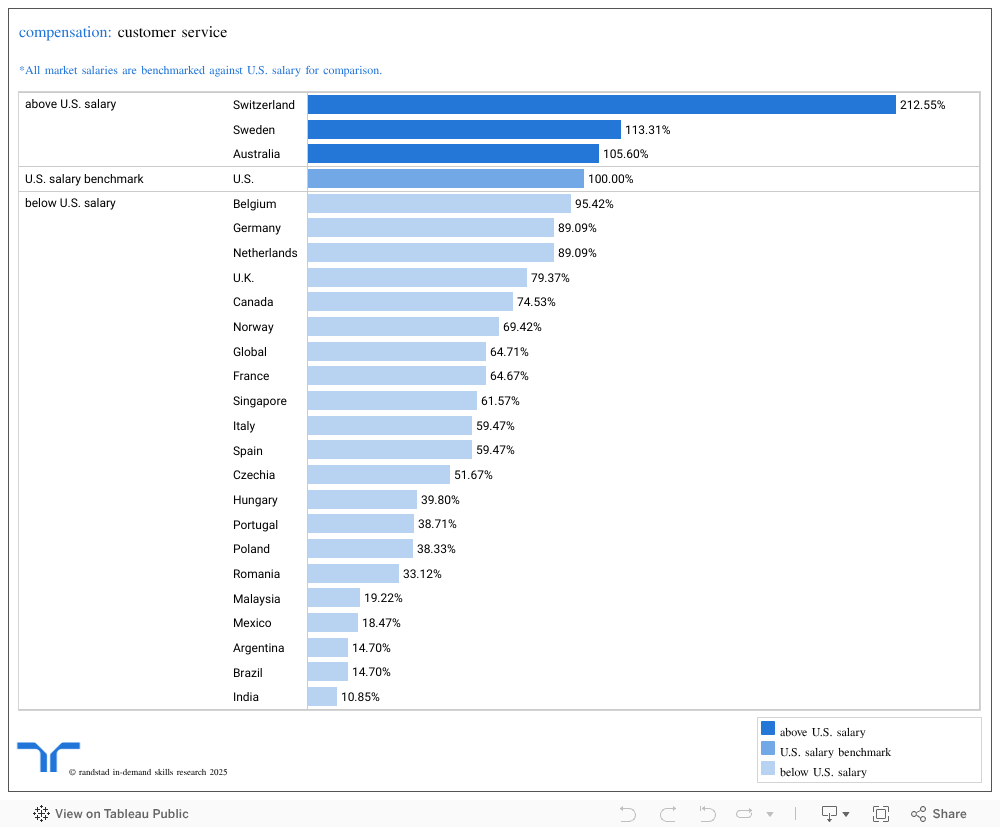
what it shows
The data included in this graph shows the average salary brackets in U.S. dollars for customer service skills in the 24 markets examined by level. Compensation data is mapped and analyzed from combined sources providing current pay data.
Select the markets of interest to understand which salary ranges are considered competitive and in which markets you should recruit to stay within budget.
need to know
- Advertised customer service salaries have not gone down alongside demand, and instead compensation sees a small global increase. The exception is a 1.9% decrease in APAC, likely due to AI pressuring some offshoring.
- The majority of jobs in customer service are junior level; therefore, effective salary levels remain well represented with regional averages and are strongly linked with average wages per market.
remote & hybrid working
what it shows
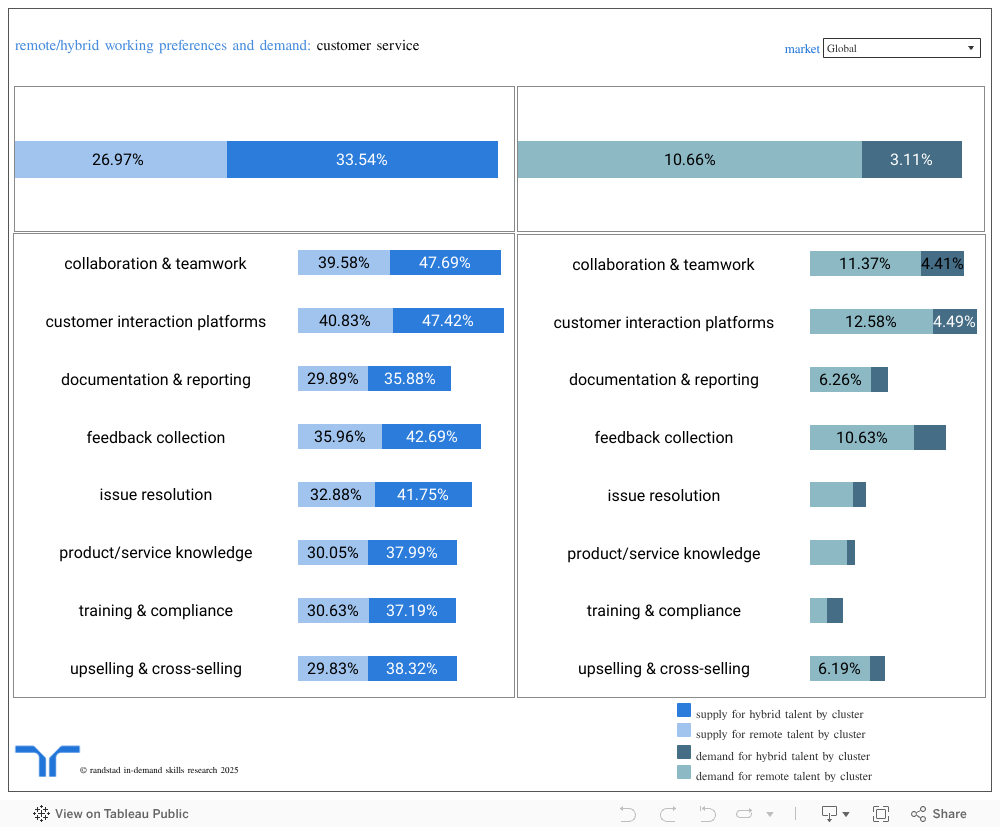
Remote working data shows the percentage of job postings that offer candidates remote or hybrid work for customer service roles (noted as “demand”), as well as talent working preferences (noted as “supply”) in each of the 24 markets researched.
It is estimated that the actual share of remote/hybrid working opportunities is higher than advertised online. You can view the data by both skill cluster and individual skills.
need to know
- This cluster has seen one of the biggest shifts in working arrangements, with remote-focused job ads increasing to 10.7% and hybrid options decreasing to 3%.
- Despite the decline in demand, there is steep year-over-year growth in talent preferences for remote and hybrid arrangements, with both increasing approximately 45%.
- Some of the highest demand for remote talent is driven by traditional European hubs for shared services centers. The majority of central European markets remain above 20% in terms of remote job ads.
take a deep dive into the in-demand skills research and find your competitive talent advantage.