choose a skill cluster

skills & motivations
This section provides a breakdown of the inherent skills, learned skills and motivations/aspirations for each skill cluster. Inherent skills and motivations/aspirations combined are commonly defined as “soft skills” in the market.
inherent skills
- 1. problem-solving ability
- 2. analytical thinking
- 3. interest in technology
- 4. adaptability
- 5. attention to detail
- 6. collaboration and teamwork
- 7. curiosity/inquisitiveness
- 8. security awareness
- 9. communication
- 10. mathematical and logical aptitude
- 11. innovative mindset
learned skills
- 1. cloud infrastructure design and deployment
- 2. cloud service management
- 3. virtualization
- 4. networking in cloud
- 5. cloud security
- 6. cloud providers and platforms
- 7. automation and orchestration
- 8. compliance and governance
motivations/aspirations
- 1. technological innovation
- 2. problem-solving and creativity
- 3. career growth and opportunities
- 4. financial rewards
- 5. impact on business and society
- 6. learning and development
- 7. collaboration/teamwork
- 8. flexibility and remote work opportunities
- 9. entrepreneurial opportunities
- 10. security and compliance challenges
- 11. sustainability
- 12. alignment with organizational goals
- 13. global reach
- 14. recognition and community involvement
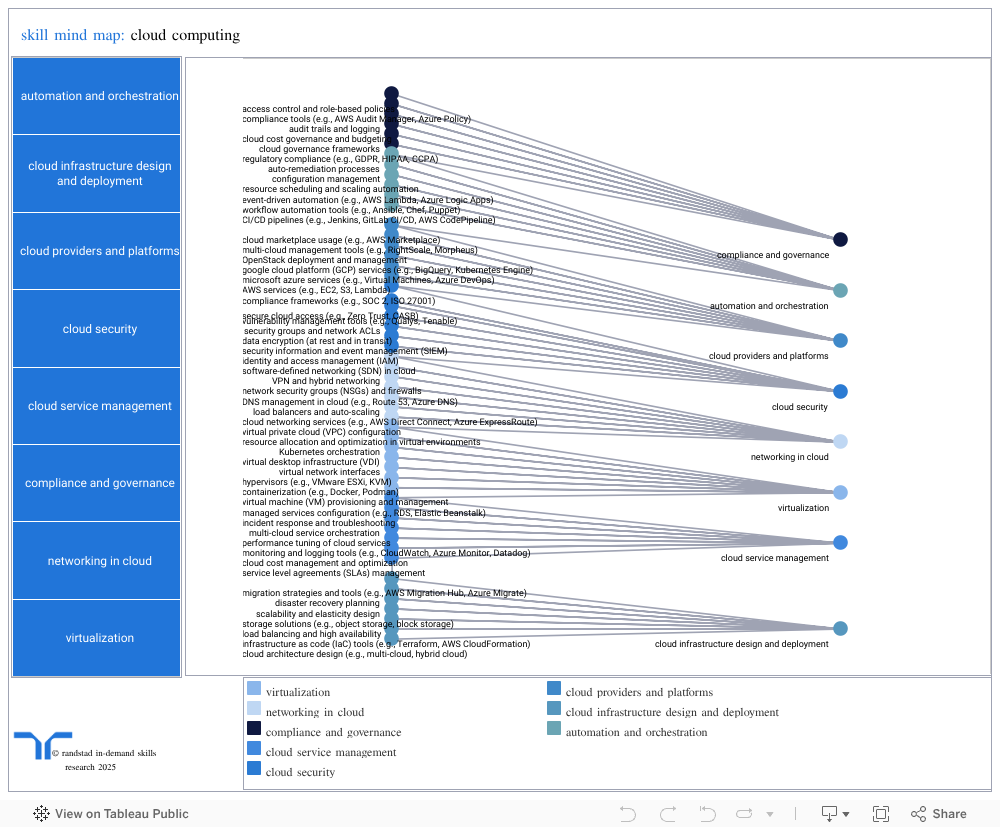
what it shows
The chart here illustrates the sub-level of learned skills required for cloud computing in each of the 24 markets researched. The findings presented here are based on a combination of verified, normalized labor market data by market and granular, skill-based data sourced from professional social media networks and job boards, as well as career sites.
need to know
- Cloud talent encompasses a range of skill clusters across various technologies and focus areas.
- While the majority of professionals specialize in one of the three main cloud platforms — Microsoft Azure, Amazon Web Services (AWS) or Google Cloud Platform (GCP) — there are strong, frequent intersections with the automation domain.
- Recently, there has also been a noticeable trend toward integrating AI-related technologies within cloud solutions.
skills supply
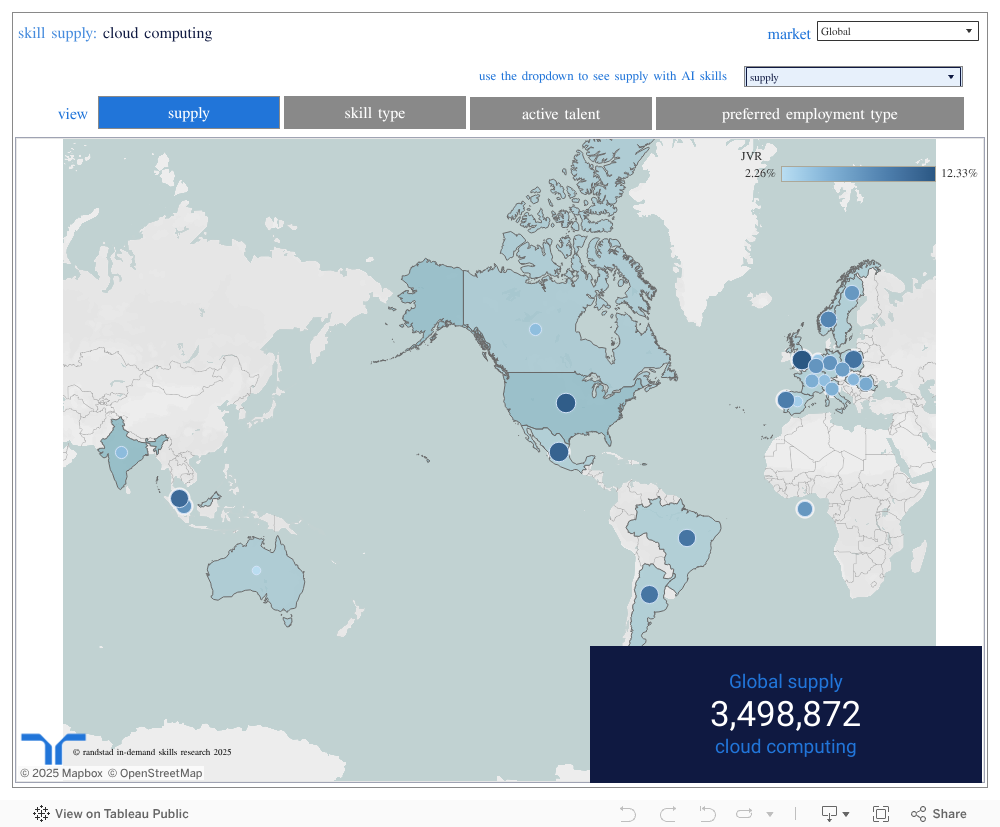
what it shows
Skills supply data indicates the total number of individuals who have the skills required for cloud computing in each of the 24 markets researched. These figures are based on a combination of verified, normalized labor market data by market and granular, skill-based data sourced from professional social media networks and job boards, as well as career sites.
Use the chart to understand the availability of skills (“supply map”), availability of sub-skills (“skill type”), talent with recent job search activity (“active talent”), as well as the share of talent who prefer permanent or contract work (“preferred employment type”).
need to know
- The cloud computing skill cluster is experiencing average growth of 1.35% year over year, but this is relatively slow compared to other tech-focused skill clusters.
- At 12.5%, the cloud computing skill cluster has the lowest mobility rate year over year, and interestingly, that number decreases for talent with AI skills. A record number of talent (67.0%) are actively looking for a job change, while talent with AI skills are looking less actively.
- Working with AI tools is well incorporated in this skill cluster; more than 16.0% of the talent supply use AI, and 8.5% of job ads require some level of AI-related experience.
skills demand
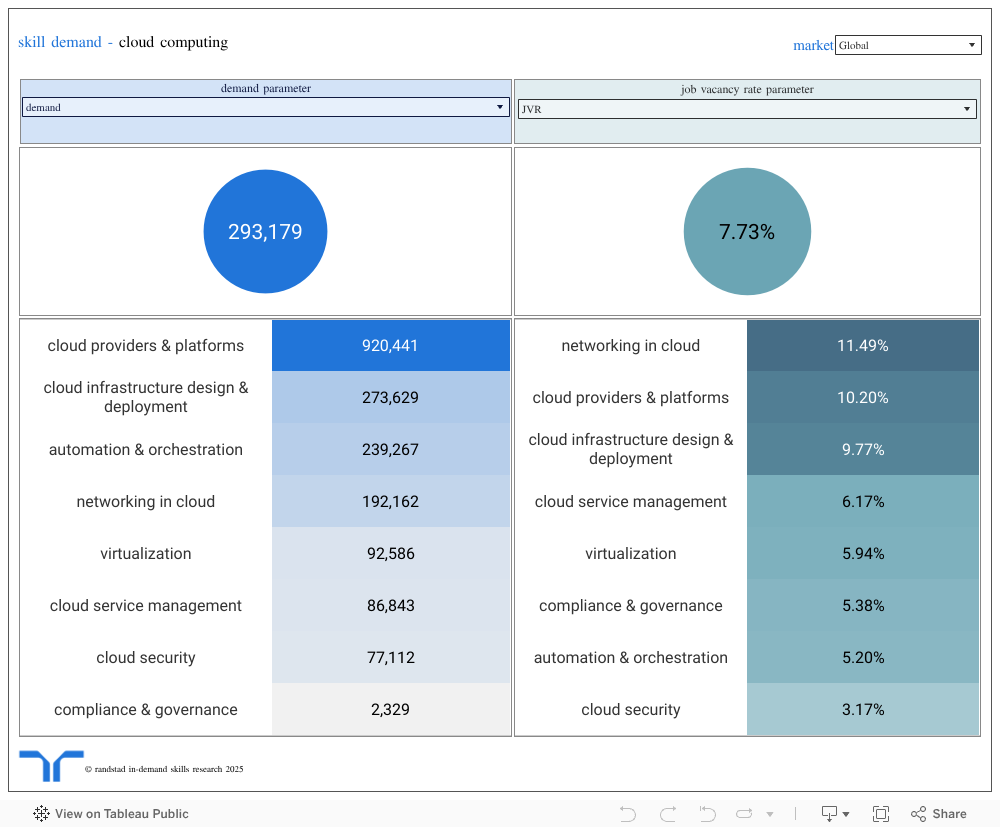
what it shows
Skills demand data indicates job postings that require cloud computing skills in each of the 24 markets we researched. These figures are based on a combination of verified, normalized labor market data by market and granular, skill-based data sourced from professional social media networks, job boards and career sites.
See demand for each skill cluster by market, explore demand for sub-skills within each cluster or view the job vacancy ratio (JVR) — defined as hiring complexity — to understand market competitiveness for these skills. The higher the JVR, the more competitive it is to recruit. 2025 demand data takes all yearly advertisements into account.
need to know
- Absolute demand, or the number of jobs throughout the year, for cloud computing specialists is on par with 2024, with an insignificant increase.
- Some of the most complex areas within this cluster have a JVR above 18%. Markets with the most hiring challenges are the U.K., the U.S. and Mexico (with JVRs above 10%), while Australia and Spain have the lowest competitive pressure, with JVRs under 4%.
- Hiring complexity for cloud computing talent with AI skills is lower, likely because a higher share of talent have these skills. There are a few markets — including Mexico and Poland — where hiring complexity for cloud skills and AI competencies is above 20%.
compensation
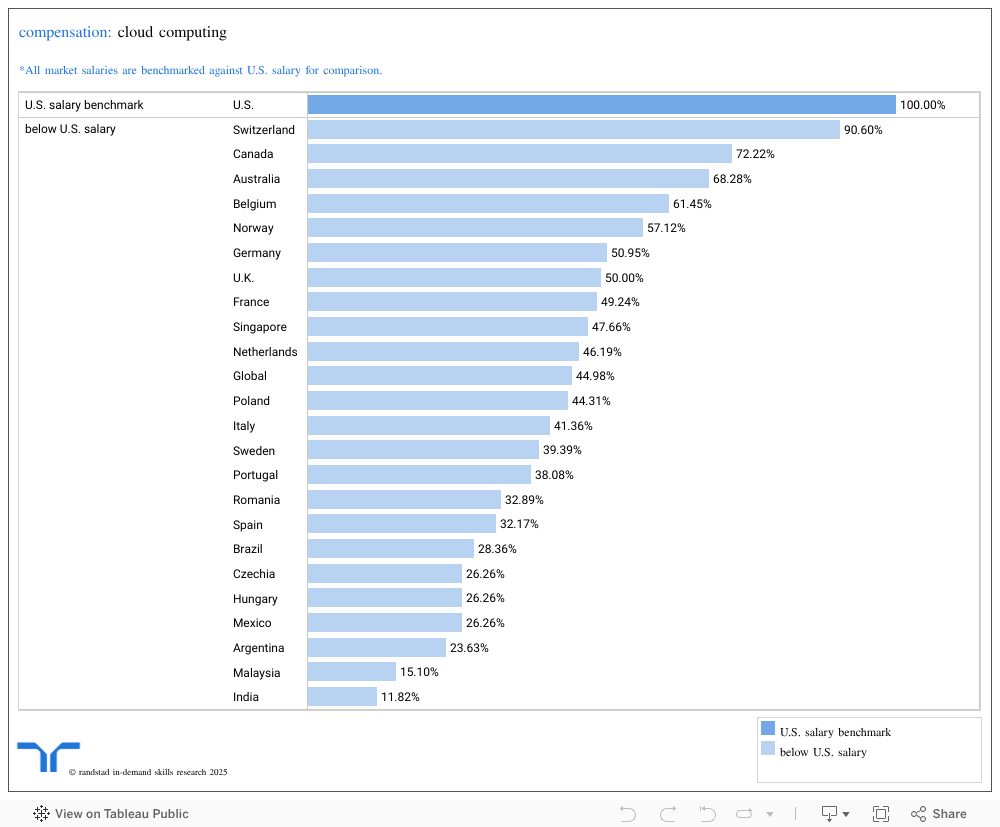
what it shows
The data included in this graph shows the average salary brackets in U.S. dollars for cloud computing skills in the 24 markets examined by level. Compensation data is mapped and analyzed from combined sources providing current pay data.
Select the markets of interest to understand which salary ranges are considered competitive and in which markets you should recruit to stay within budget.
need to know
- Cloud computing salary levels are inconsistent across regions, although they all lean toward a slight decline. In the U.S., salaries are down 1.2%, and in APAC, they have dropped 5.3%. Meanwhile, EMEA shows a minor increase of 1.9%.
- Salary changes across regions suggest a shift to more junior cloud computing jobs in the APAC region, while relative salary stagnation in other regions is likely the result of IT functions being reorganized.
remote & hybrid working
what it shows
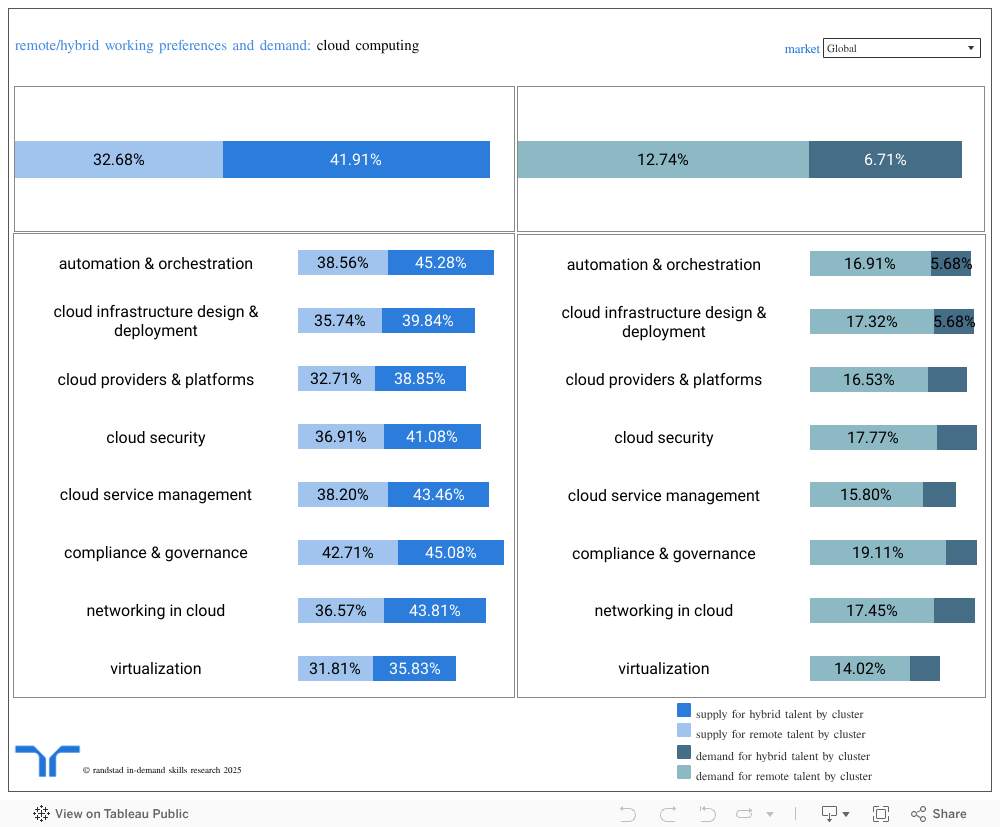
Remote working data shows the percentage of job postings that offer candidates remote or hybrid work for cloud computing roles (noted as “demand”), as well as talent working preferences (noted as “supply”) in each of the 24 markets researched.
It is estimated that the actual share of remote/hybrid working opportunities is higher than advertised online. You can view the data by both skill cluster and individual skills.
need to know
- The cloud computing skill cluster is one of the most remote-friendly, with a high percentage of job ads offering remote and hybrid options (12.7% and 6.7%, respectively). This is a significant year-over-year increase for remote (up 40%) and a bigger decrease for hybrid (down 49%).
- The preference for remote work among cloud computing professionals has increased significantly, up by 40% year over year.
- The markets with the highest demand for remote talent are the U.K., the U.S. and Italy (all above 17%), while France, Malaysia and Netherlands show the lowest (all below 2%).
take a deep dive into the in-demand skills research and find your competitive talent advantage.