choose a skill cluster

take me to:
skills & classification
The skilled trades examined in our Global In-Demand Skills research are based on ISCO-08 level 2 categories, gathered from the International Labor Organization (ILO). This is aggregated data for 24 markets. The skills included within each category are listed below.
retail & direct sales
- ISCO-08 2 digit level: 52, sales workers
nursing & medical care
- ISCO-08 2 digit level: 32, health associate professionals
- ISCO-08 2 digit level: 53, personal care workers
maintenance & repair
- ISCO-08 2 digit level: 93, laborers in mining, construction, manufacturing and transport
- ISCO-08 2 digit level: 74, electrical and electronic trade workers
- ISCO-08 2 digit level: 72, metal, machinery and related trades workers
manufacturing & plant operations
- ISCO-08 2 digit level: 83, drivers and mobile plant operators
- ISCO-08 2 digit level: 82, assemblers
- ISCO-08 2 digit level: 81 stationary plant and machine operators
skills hiring complexity
what it shows
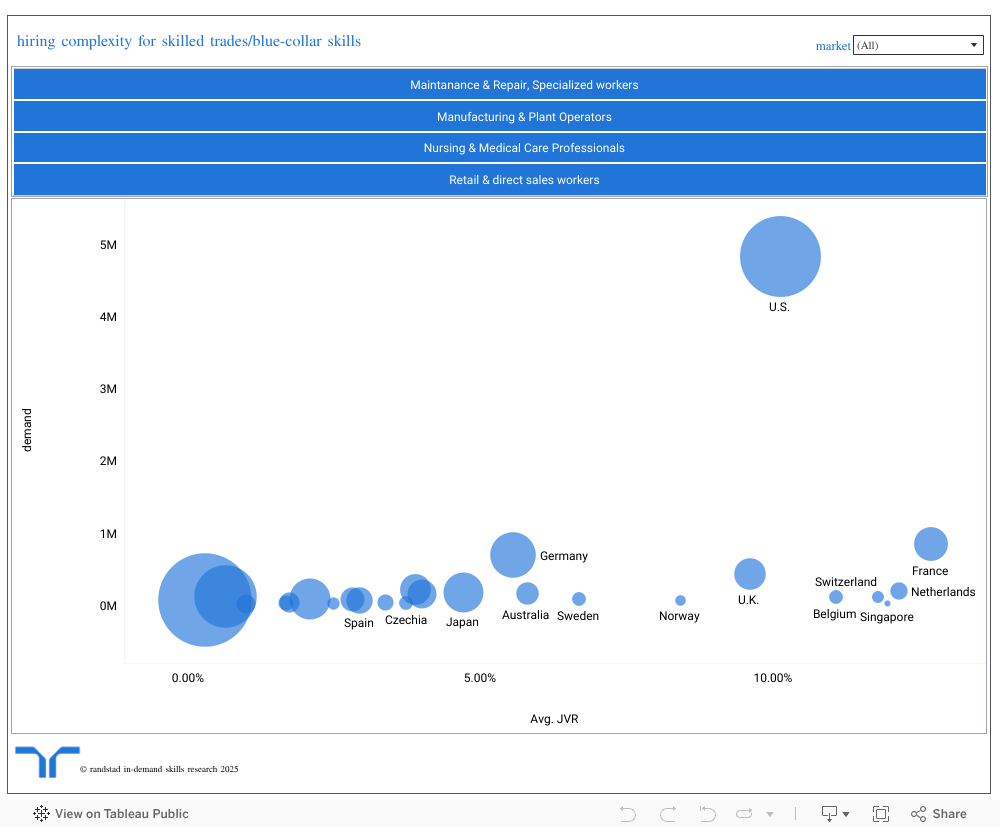
Skills hiring complexity data represents the job vacancy rate (JVR), also known as “hiring complexity,” derived from skill supply and demand information for each profile under ISCO-08 2-digit classification across 24 markets. Demand accounts for a period of 12 months.
These figures are based on a combination of verified, normalized labor market data by market and granular, skill-based demand data gathered from job boards, job aggregators and career sites.
See hiring complexity for each skilled trade by market and explore information about job advertisement and supply levels for each. The higher the JVR, the more competitive it is to recruit for that skill.
need to know
Local hiring complexity for skilled trades fluctuates a great deal alongside local investments. Highly skilled talent remains relatively resilient to market changes, but more junior talent tends to shift in-between jobs. Western economies have been experiencing severe talent scarcity for these roles over the past decade, and that trend is worsening, even as market demand stabilizes below post-2023 peak levels.
One of the particularly strong trends emerging in this year's edition is a severe lack of client-facing talent across most developed economies. With unemployment levels across the globe remaining relatively low, filling roles in retail is a consistent challenge due to the role's perceived attractiveness and competing talent aspirations.
-
increased retail hiring complexity
- Markets like France, the U.K. and the U.S. face perpetual challenges in filling retail roles.
- Notably, even markets with relatively high unemployment rates, such as Spain, are reporting above-average levels of hiring complexity.
-
maintenance staff shortages
- Shortages of experienced maintenance talent are most acute in Western Europe.
- The Netherlands and Belgium are among the markets with the most severe shortages, surpassed only by Singapore.
-
fluctuating demand for factory operators
- Hiring complexity for factory operators is much less pronounced, considering their baseline requirements are relatively lower and skills are more transferable.
- Nevertheless, even in markets that have recently struggled due to global economic shifts — like Germany — hiring this type of talent still remains relatively difficult.
take a deep dive into the in-demand skills research and find your competitive talent advantage.