choose a skill cluster

skills & motivations
This section provides a breakdown of the inherent skills, learned skills and motivations/aspirations for each skill cluster. Inherent skills and motivations/aspirations combined are commonly defined as “soft skills” in the market.
inherent skills
- 1. analytical and problem-solving skills
- 2. detail-oriented
- 3. communication and interpersonal skills
- 4. ethical and principled approach to compliance and risk management
- 5. ability to adapt to changing regulatory environments and industry trends
learned skills
- 1. regulatory compliance
- 2. risk management
- 3. internal control systems
- 4. audit tools and software
- 5. reporting
- 6. quality assurance
- 7. ethical and legal compliance
motivations/aspirations
- 1. integrity and ethical consideration
- 2. problem-solving and analytical challenges
- 3. impact on organizational health
- 4. professional growth and development
- 5. financial rewards and job stability
- 6. alignment with personal and organizational values
- 7. working within a framework of rules and standards
- 8. collaboration and teamwork
- 9. recognition and status
- 10. social responsibility and contributing to society
- 11. adapting to changing regulations
- 12. risk management
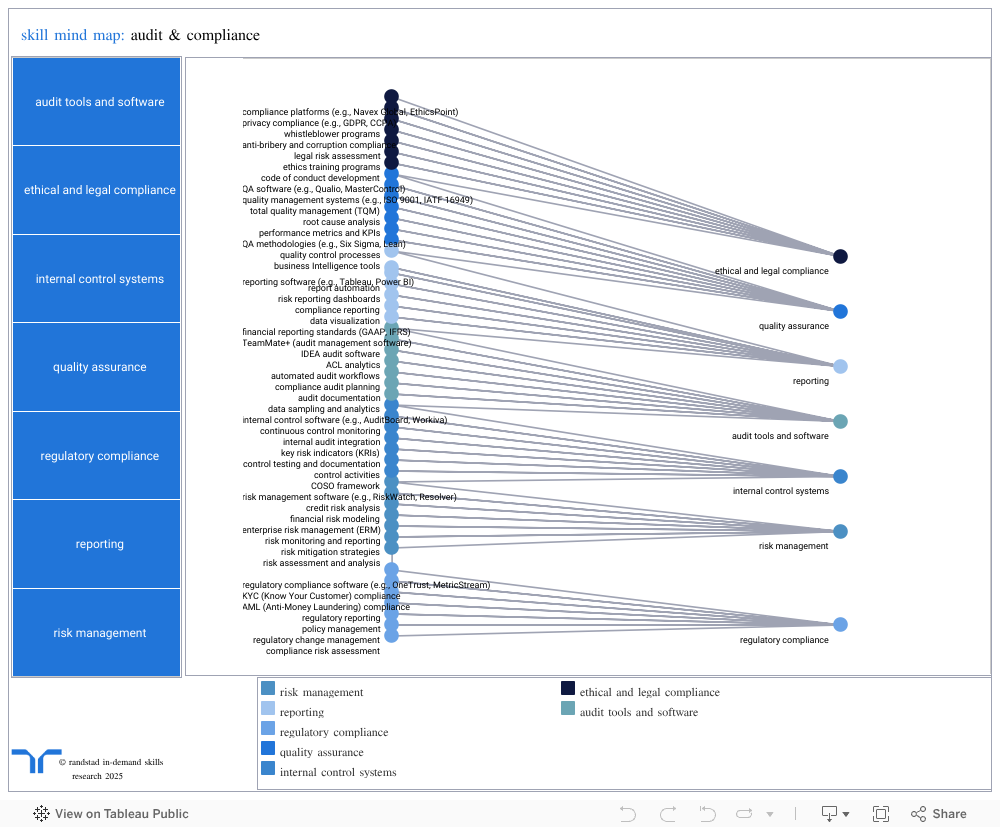
what it shows
The chart here illustrates the sub-level of learned skills required for audit and compliance in each of the 24 markets researched. The findings presented here are based on a combination of verified, normalized labor market data by market and granular, skill-based data sourced from professional social media networks and job boards, as well as career sites.
need to know
- While audit and compliance skills apply to broad regulatory categories, in-depth knowledge of local and regional regulations is essential.
- Due to the distinct and specific regulatory knowledge required across markets and industries, audit and compliance skills rarely translate seamlessly into global roles.
- The most commonly identified specialized audit and compliance skills include financial and business risk analysis, investment advisory, taxation, and commercial banking.
skills supply

what it shows
Skills supply data indicates the total number of individuals who have the skills required for audit and compliance in each of the 24 markets researched. These figures are based on a combination of verified, normalized labor market data by market and granular, skill-based data sourced from professional social media networks and job boards, as well as career sites.
Use the chart to understand the availability of skills (“supply map”), availability of sub-skills (“skill type”), talent with recent job search activity (“active talent”), as well as the share of talent who prefer permanent or contract work (“preferred employment type”).
need to know
- The audit and compliance talent pool continues to expand slowly, maintaining a senior-heavy profile with over 80% of professionals bringing 10+ years of experience.
- Talent mobility remains low, with only 13.3% changing jobs in the past year, and 45.0% open to new opportunities.
- Interest in contract work has nearly doubled year over year, rising to 16.7%, as productivity pressures and shifting priorities drive greater flexibility across the workforce.
- AI proficiency remains limited, but adoption is increasing, particularly among professionals specializing in AI governance and risk controls.
skills demand
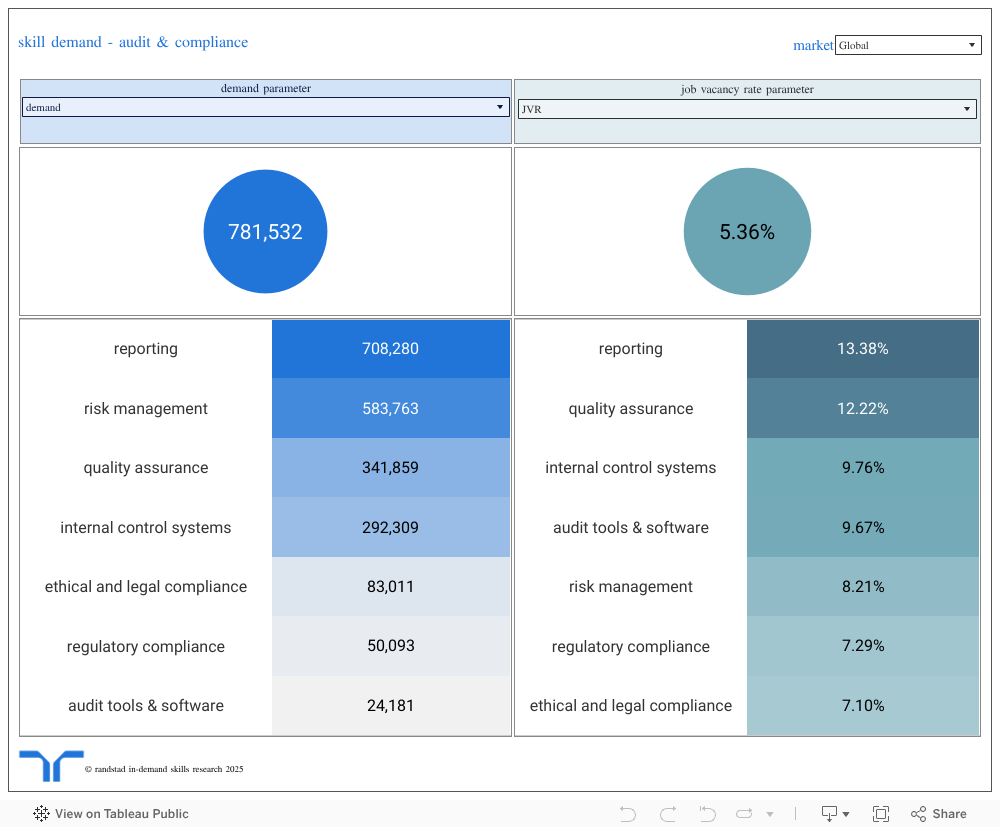
what it shows
Skills demand data indicates job postings that require audit and compliance skills in each of the 24 markets we researched. These figures are based on a combination of verified, normalized labor market data by market and granular, skill-based data sourced from professional social media networks, job boards and career sites.
See demand for each skill cluster by market, explore demand for sub-skills within each cluster or view the job vacancy ratio (JVR) — defined as hiring complexity — to understand market competitiveness for these skills. The higher the JVR, the more competitive it is to recruit. 2025 demand data takes all yearly advertisements into account.
need to know
- Demand for audit and compliance skills has risen by 1.5% after two years of decline, making it the only non-tech cluster to grow this year.
- Over 73% of postings target senior roles, driving persistent hiring challenges — especially in Germany and France.
- Internal control systems and quality assurance remain the toughest sub-skills to fill; JVRs for both exceed 18% across LATAM markets.
- Demand for AI governance and ethical compliance roles continues to rise, expanding faster than in 2024.
compensation
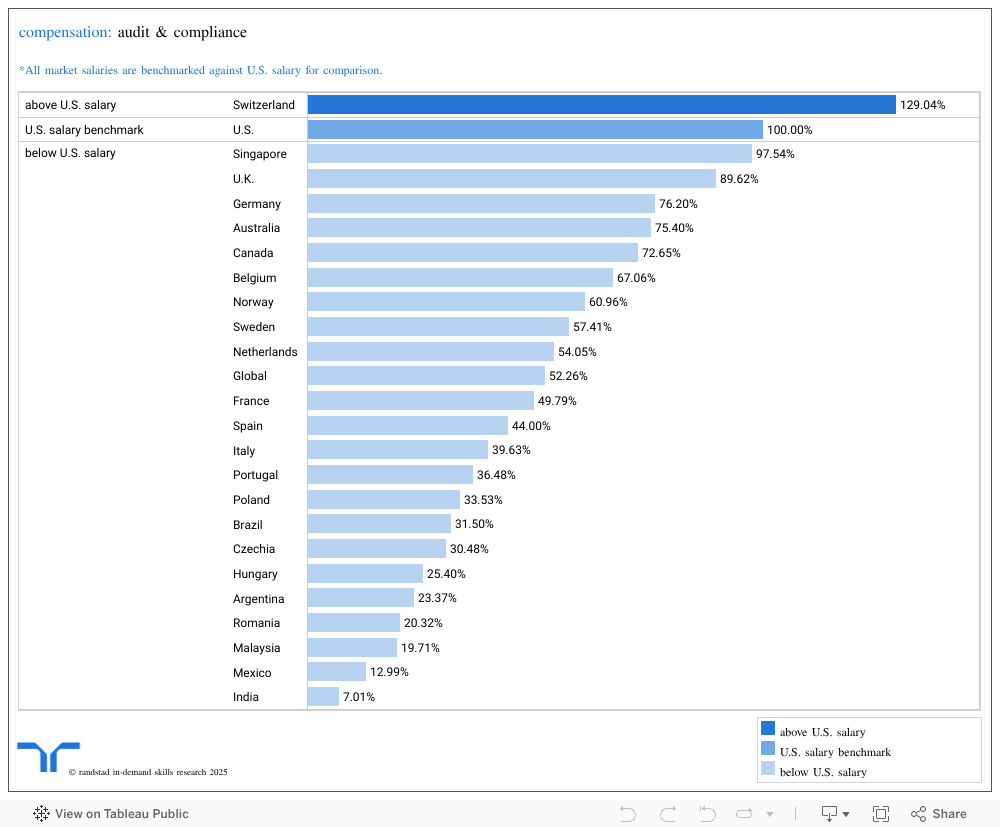
what it shows
The data included in this graph shows the average salary brackets in U.S. dollars for audit and compliance skills in the 24 markets examined by level. Compensation data is mapped and analyzed from combined sources providing current pay data.
Select the markets of interest to understand which salary ranges are considered competitive and in which markets you should recruit to stay within budget.
need to know
- Average compensation has increased globally, with EMEA salaries growing 7.8% compared to a slight rise last year.
- Salaries remain steady in the U.S., while India and Malaysia continue to report lower averages.
- Rising pay reflects increased demand for senior talent versed in AI regulation and data protection compliance.
remote & hybrid working
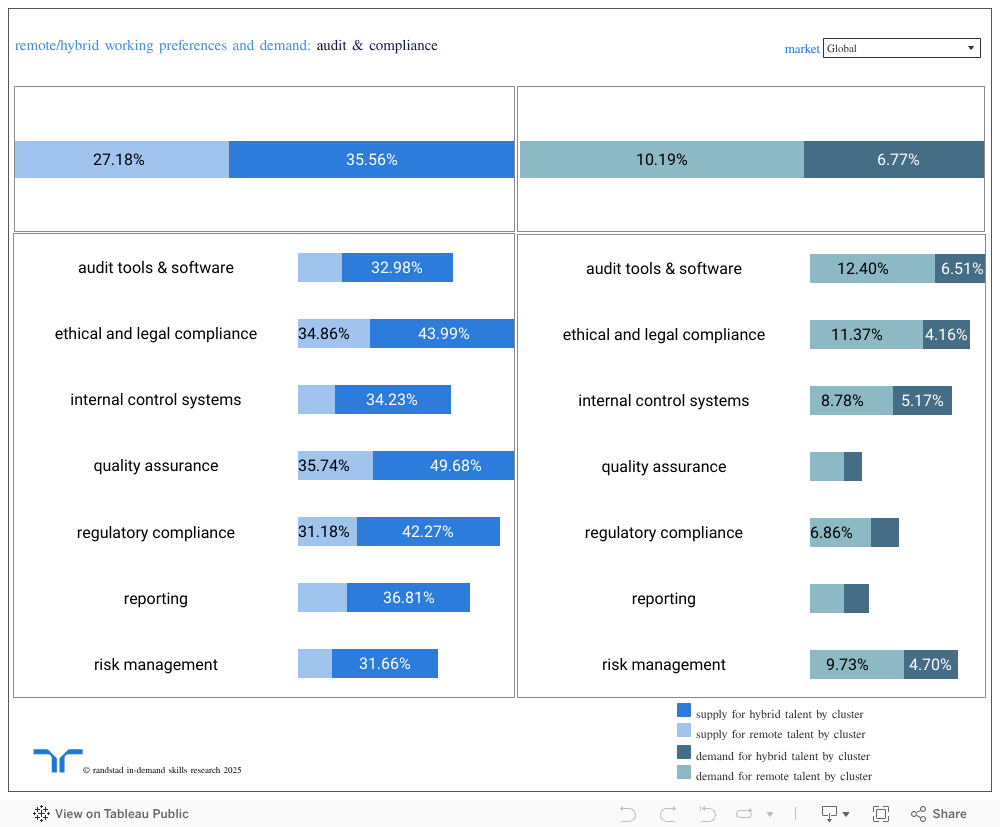
what it shows
Remote working data shows the percentage of job postings that offer candidates remote or hybrid work for audit and compliance roles (noted as “demand”), as well as talent working preferences (noted as “supply”) in each of the 24 markets researched.
It is estimated that the actual share of remote/hybrid working opportunities is higher than advertised online. You can view the data by both skill cluster and individual skills.
need to know
- Remote opportunities have expanded sharply to 10.2% year over year (up from 3.0% last year), while hybrid roles have declined slightly to 6.7%.
- Talent adoption of remote and hybrid models has nearly doubled, though audit and compliance remains among the least remote-enabled clusters.
- With more than 20% of their postings offering remote work, Hungary, the Netherlands, Poland, the U.K., the U.S., and Spain lead in flexible work offerings.
take a deep dive into the in-demand skills research and find your competitive talent advantage.